FOR IMMEDIATE RELEASE
New capability gives product marketing a structured workspace for the stories revenue teams take to market
- Segment8 launches Messaging Frameworks, giving product marketing managers a five-category structured workspace to build, maintain, and distribute positioning narratives across the revenue organisation.
- Go-to-market teams now compete in markets where buyers have access to the same competitive information as sellers. Positioning that was accurate last quarter may already be out of date before the next call.
- Messaging Frameworks turn slide-deck positioning into a living GTM asset, with intelligence scoring that surfaces completeness gaps before messaging reaches the field.
- The module helps PMMs keep core positioning, ICP definition, key messages, discovery guidance, and feature narratives connected in one workspace.
MANCHESTER, UK, February 7, 2025 — Segment8, the GTM Intelligence Platform for revenue teams competing in active markets, today announced the launch of Messaging Frameworks, a structured workspace for product marketing managers to build, maintain, and distribute positioning narratives across the revenue organisation.
Sales messaging in many B2B organisations still lives in presentation decks, shared documents, launch folders, and one-off enablement sessions. Those assets may be carefully written when created. They rarely keep pace with the market once competitors change their claims, buyers shift their priorities, or product teams release new capabilities.
The problem has become more visible as buyers arrive with more context. Prospects now conduct extensive pre-call research across analyst reports, peer reviews, social feeds, competitor websites, customer stories, and AI-generated summaries. By the time they speak to a seller, they may already have formed a view of the category, the vendors, and the trade-offs.
That raises the standard for revenue messaging. A seller who repeats an old value proposition, uses dated competitive language, or cannot connect the story to the buyer’s current priorities loses credibility quickly. The gap may begin with positioning, but it shows up in pipeline: weaker discovery, vague differentiation, inconsistent talk tracks, and sales conversations that drift away from the company’s intended narrative.
AI has accelerated the pressure. Competitive repositioning, new product claims, pricing experiments, and category narratives now move faster than most PMM review cycles. A competitor can change a homepage, publish new comparison content, release a customer story, and distribute revised messaging across its channels before many revenue teams have updated their own field guidance.
Segment8 Messaging Frameworks gives product marketing teams a structured workspace for that work.
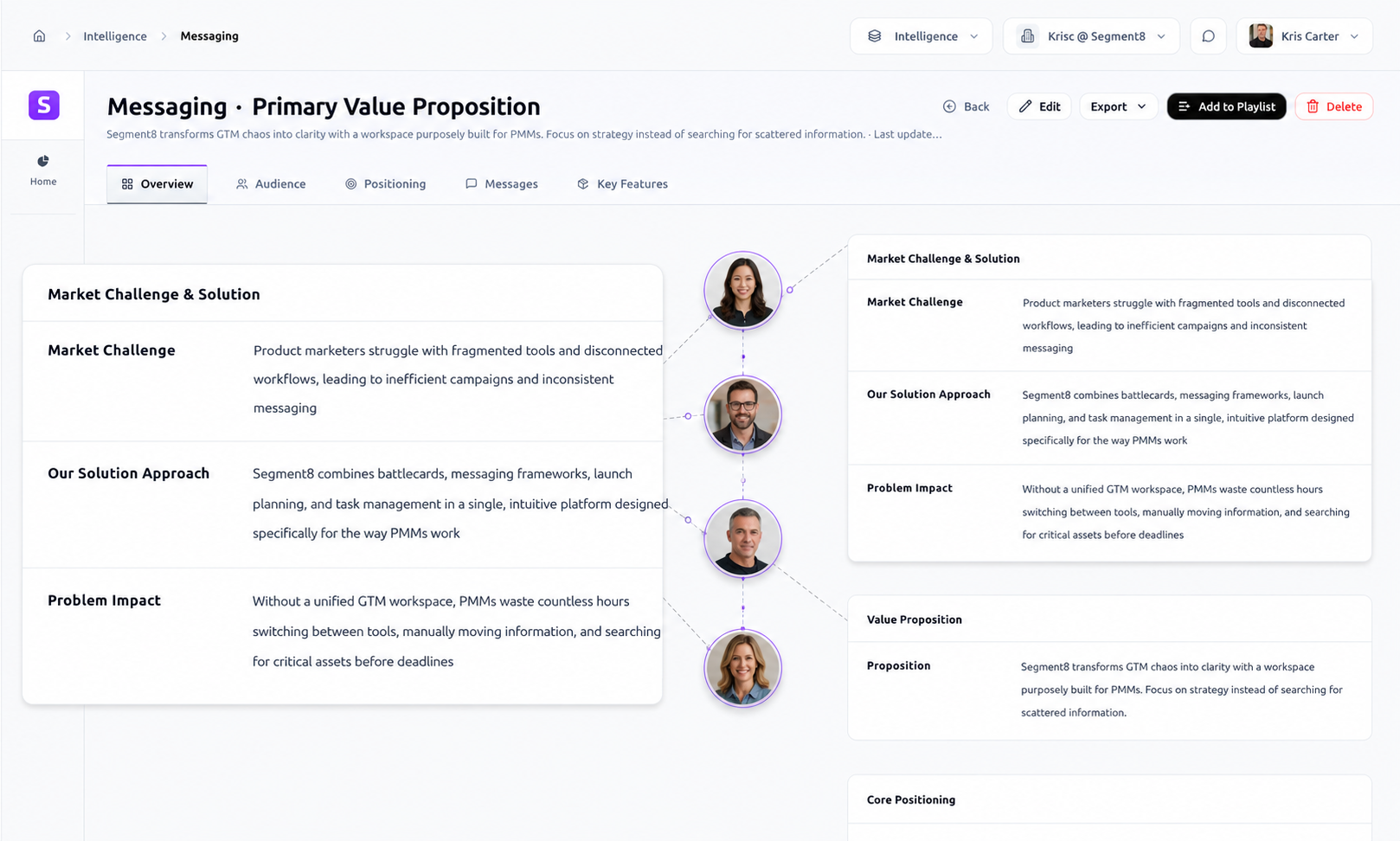
The module is organised around five categories: core positioning, ideal customer profile, key messages, discovery questions, and key features. PMMs can define the central narrative, document the audience the message is built for, capture the pain points and triggers that shape buying interest, and connect the story to the product capabilities the field needs to explain.
This structure helps product marketing keep the revenue narrative coherent. Core positioning anchors the story. ICP guidance defines who the message is meant for. Key messages translate the strategic narrative into usable talk tracks. Discovery questions help sellers test whether the message applies. Feature narratives connect product capability to customer value.
"I spent years as the PMM responsible for the revenue narrative, at Procore, Eastnets, and Featurespace," said Kris Carter, Founder of Segment8. "The pattern kept repeating. We would spend weeks getting the messaging right: internal review, leadership sign-off, launch deck, enablement session. Then six months later, I would listen to a sales call and hear something completely different. Sometimes the rep had not found the update. Sometimes the update had reached them in a format they could not use. Sometimes the market had moved faster than the document. Messaging Frameworks is built for the world we now operate in, where buyers arrive better informed and messaging has to stay accessible, current, and usable."
Intelligence scoring surfaces completeness gaps across the framework, giving PMMs a clear view of whether a message is ready for the field. A framework with strong positioning but weak discovery guidance may create a good deck and a poor sales conversation. A framework with clear ICP notes but thin feature narrative may help targeting while leaving sellers underprepared for product-level questions. Segment8 makes those gaps visible before the message travels into the market.
That matters because messaging quality often degrades during distribution. Product marketing may write a precise narrative, but sellers need the usable version: the opening line, the customer problem, the proof point, the question to ask, the feature to emphasise, and the language to avoid. Messaging Frameworks gives PMMs a way to connect the strategic version and the field version in one place.
Frameworks can be exported as PDF Narrative Messaging Briefs or Excel documents and bundled into Segment8 Playlists for direct delivery to the field. This supports both internal planning and practical sales enablement. Teams can maintain the messaging in Segment8 while distributing field-ready versions to sellers, managers, partners, agencies, consultants, and new hires.
For product marketing teams, the module provides a more disciplined way to manage positioning as the market changes. Instead of rewriting decks from scratch or relying on scattered documents, PMMs can maintain a living framework that reflects current ICP, current product value, current competitive dynamics, and current discovery needs.
For sellers, Messaging Frameworks provide clearer guidance before customer conversations. They can see what the company believes, who the message applies to, what questions to ask, and how to connect the story to buyer pain. This reduces the need for sellers to improvise their own value propositions when time is short.
For sales leaders, the capability supports greater consistency across the field. Teams can reinforce the same core narrative, adjust talk tracks as the market changes, and reduce the drift between what leadership approved and what buyers hear in live conversations.
For founders and revenue operators, the module creates a clearer operating layer for narrative control. Messaging becomes easier to review, improve, distribute, and inspect. When market signals, win-loss findings, or deal feedback show that a message needs to change, product marketing has a structured place to make that change and send it back into the field.
Messaging Frameworks also connect naturally to the wider Segment8 platform. Competitive Battlecards show how the company positions against specific competitors. Buyer Personas show how different stakeholders think, buy, and object. Launch Plans translate product delivery into market execution. Win-Loss Intelligence captures what buyers say after deals conclude. Messaging Frameworks give teams the narrative layer that ties those signals together.
The module launches alongside Competitive Battlecards as part of Segment8's founding GTM Intelligence Platform release. Together, the two capabilities give product marketing teams a single workspace for competitive intelligence and positioning, two functions that shape the same customer conversations but are often maintained in separate tools.
"Messaging is not finished when the deck is approved," Carter added. "It has to survive contact with the field, the buyer, and the market. That means it needs structure, ownership, distribution, and a way to stay current. Messaging Frameworks gives product marketing that operating layer."
Messaging Frameworks is available to Segment8 subscribers as part of the GTM Intelligence Platform.
Revenue teams can request a demo at segment8.com/demo.
About Segment8
Segment8 is the GTM Intelligence Platform for revenue teams competing in active markets. It connects market signals, win-loss intelligence, and field enablement in one platform so market intelligence reaches sellers before the deal is decided. Based in Manchester, UK.
Media contact
Kris Carter
Founder, Segment8
[email protected]