FOR IMMEDIATE RELEASE
New capability turns automated market monitoring into structured, classified competitive intelligence delivered before the next deal conversation
- Segment8 launches Market Signals, an automated competitive monitoring capability that continuously ingests market movement across news, job boards, press releases, and corporate sources, classifies each signal by type, and routes structured intelligence to the revenue teams that need it.
- AI has inverted the information scarcity problem for competitive intelligence. The challenge has moved from finding signals to processing, classifying, and routing them faster than the market moves.
- Market Signals makes the Segment8 GTM Intelligence Platform proactive, with competitive intelligence reaching the workspace continuously rather than depending on a PMM to conduct manual research and push it into the field.
- The capability gives product marketing and revenue teams a live view of competitor movement across funding, product, people, hiring, M&A, legal, pricing, roadmap, and retrenchment signals.
The time between a competitor's move and a buyer's awareness of it has never been shorter. Segment8's new Market Signals capability helps revenue teams close that gap with automated ingestion, classification, and routing of competitive intelligence across nine signal categories, running continuously without manual monitoring.
MANCHESTER, UK, January 1, 2026 — Segment8, the GTM Intelligence Platform for revenue teams competing in active markets, today announced the launch of Market Signals, an automated competitive intelligence monitoring capability that continuously ingests market movement across news, press releases, job boards, and corporate sources, classifies each signal by type, and delivers structured intelligence to the revenue teams that need to act on it.
The time between a competitor making a move and a seller knowing about it used to be measured in days or weeks. That window has narrowed. AI-powered news distribution, automated social monitoring, real-time financial data, and always-on market commentary mean a competitor's funding announcement can reach an investor's feed within hours and a buyer's LinkedIn within the same day.
That creates a hard operating problem for revenue teams. Manual competitive monitoring cannot keep pace with the market it is meant to track. Bookmarking articles, forwarding press releases, scanning job boards, posting into Slack, and hoping the right people notice creates a fragile system. It depends on individual effort, spare capacity, and memory. Active markets punish that model.
The result is a familiar failure. The signal exists, but it reaches the field too late, with too little context, or in a channel where it disappears. A competitor launches a new product capability. A hiring pattern suggests a new market push. A pricing page changes. A senior leader leaves. A company announces funding. Each signal may matter. Most organisations lack a consistent operating layer to capture, classify, and route those signals before they affect live deals.
Segment8 Market Signals gives revenue teams that operating layer.
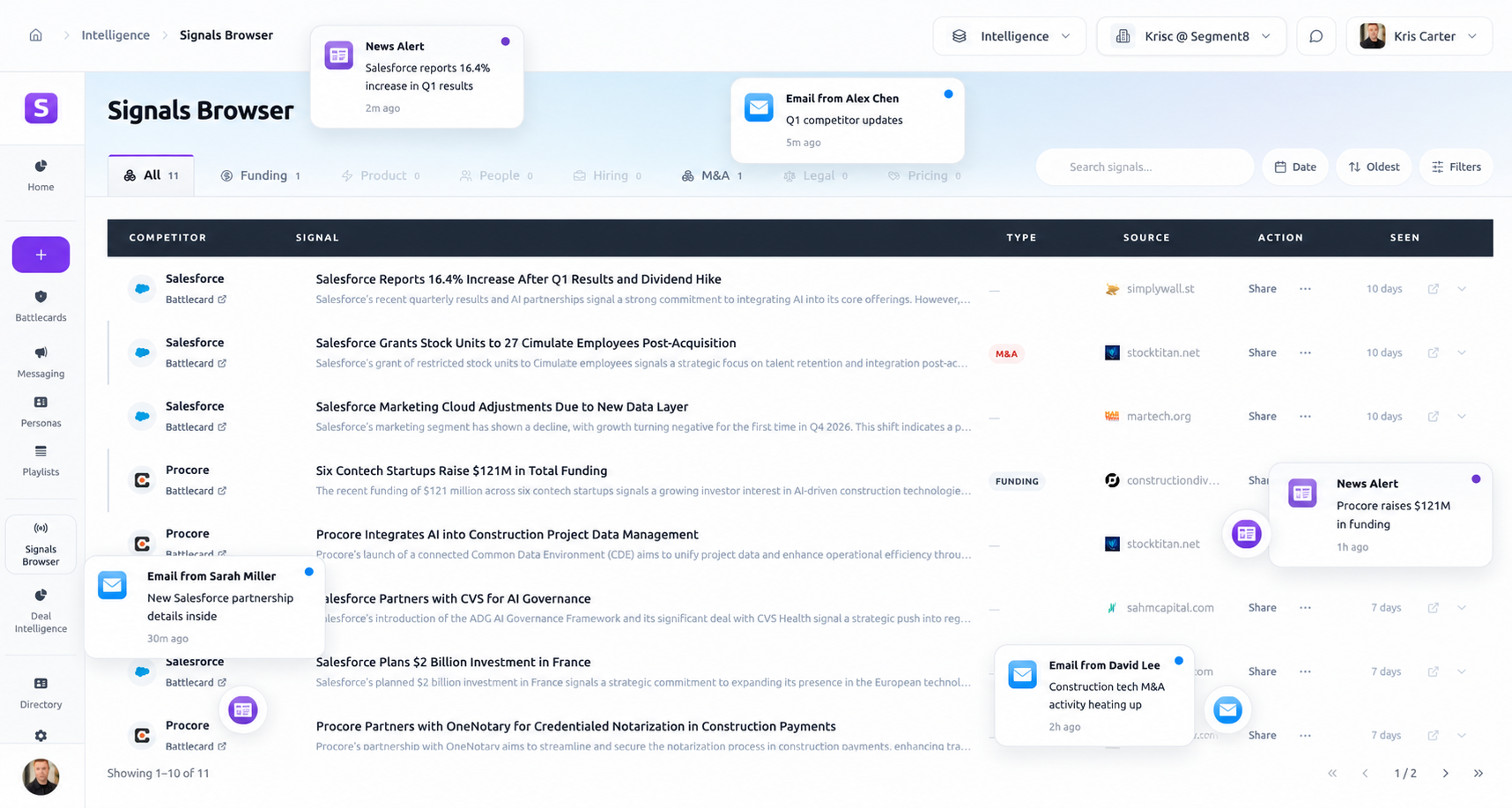
Market Signals automatically monitors competitor activity across nine signal categories: Funding, Product Launch, People and Job Change, Hiring, Mergers and Acquisitions, Legal, Pricing, Roadmap, and Retrenchment. Each signal is classified with a confidence score and impact rating based on proximity to the company, strength of evidence, and timing relevance.
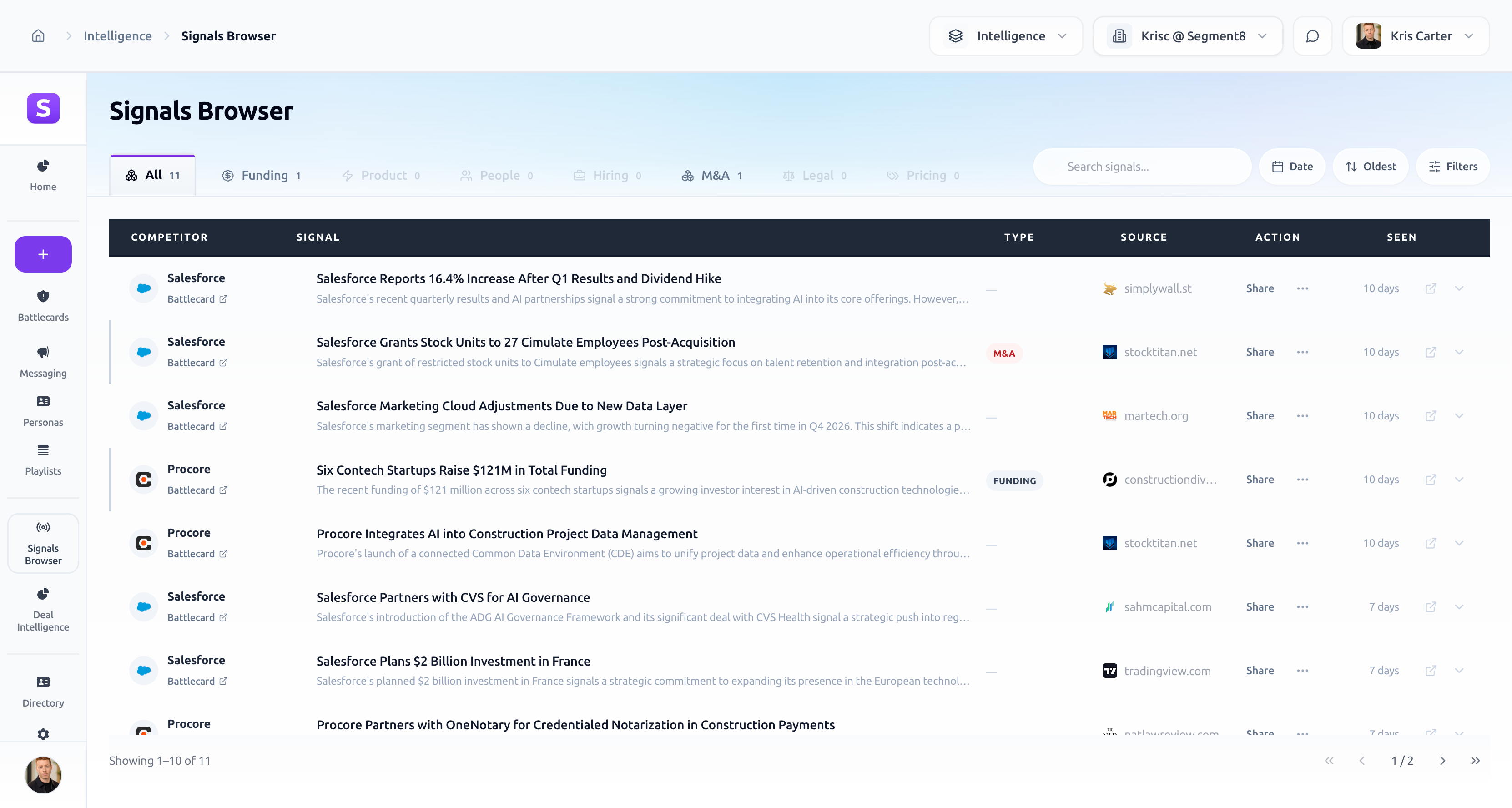
Signals that meet quality thresholds are promoted into a structured intelligence browser where product marketing teams can filter by type, date, and competitor. Teams can review the signal, share it to distribution lists and Slack channels, and manually reclassify signals that need closer judgement. This gives PMMs a continuous feed of market movement without requiring them to run the same monitoring routine every morning.
"I spent years monitoring competitive landscapes manually, setting up Google alerts, scanning news feeds every morning, forwarding articles to Slack, and hoping the right people saw them," said Kris Carter, Founder of Segment8. "At Procore, we were competing in a category being disrupted from multiple directions at once. At Featurespace, competitive intelligence could affect the difference between winning an RFP and losing it. What I kept observing was simple: the tools available to competitive intelligence teams were not built for the pace at which markets were moving. AI has made that pace faster still. Market Signals is the infrastructure layer that makes competitive monitoring continuous, structured, and connected to the content and decisions it should influence."
Market Signals draws on a continuously updated ingestion pipeline covering sources including TechCrunch, VentureBeat, Yahoo Finance, PR Newswire, Ars Technica, LinkedIn job boards, and corporate blog feeds. Signals are routed to the competitors each workspace tracks, keeping intelligence relevant to the specific competitive landscape each team operates in.
The capability is designed to reduce the noise that usually comes with market monitoring. Not every mention matters. Not every article deserves a sales alert. Not every product update should change positioning. Segment8 classifies signals by type, scores their likely impact, and gives teams a clearer way to decide which signals require action.
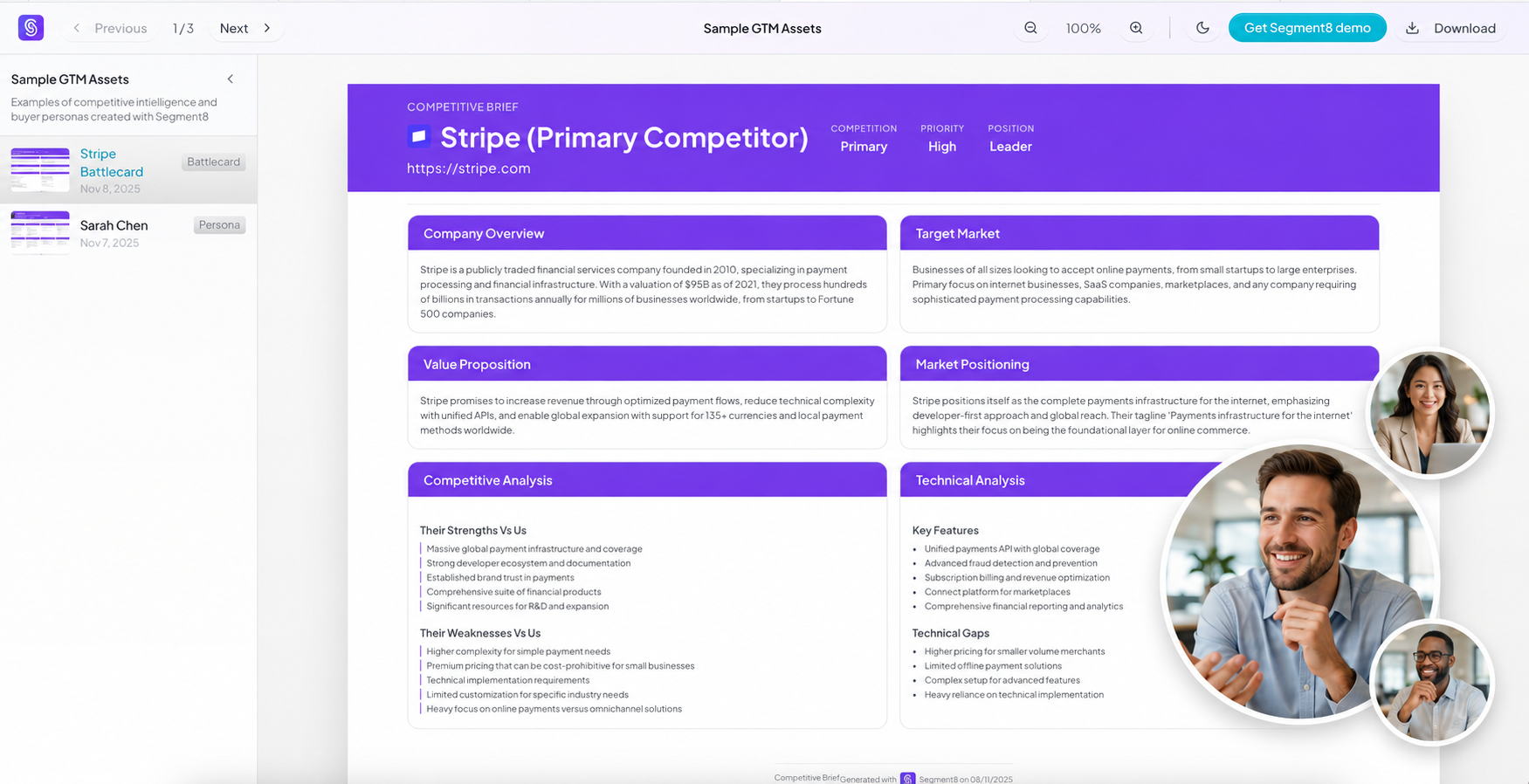
For product marketing teams, this creates a faster path from market movement to field guidance. A funding signal may trigger a review of competitor messaging or enterprise sales motion. A hiring signal may reveal where a competitor is investing. A pricing signal may require a change to objection handling. A roadmap signal may shape product feedback and sales enablement. Market Signals gives PMMs a structured way to connect those movements to the GTM assets they maintain.
For sellers and sales leaders, the value is timing. Competitive intelligence has limited value when it arrives after the deal conversation. Market Signals helps teams spot competitor movement earlier, understand why it may matter, and route the right context before the next call.
For founders and revenue operators, the capability creates visibility across the competitive landscape without turning competitive monitoring into another manual operating burden. Teams can see which competitors are moving, what type of movement is occurring, and where the market may be shifting before it appears in win-loss patterns.
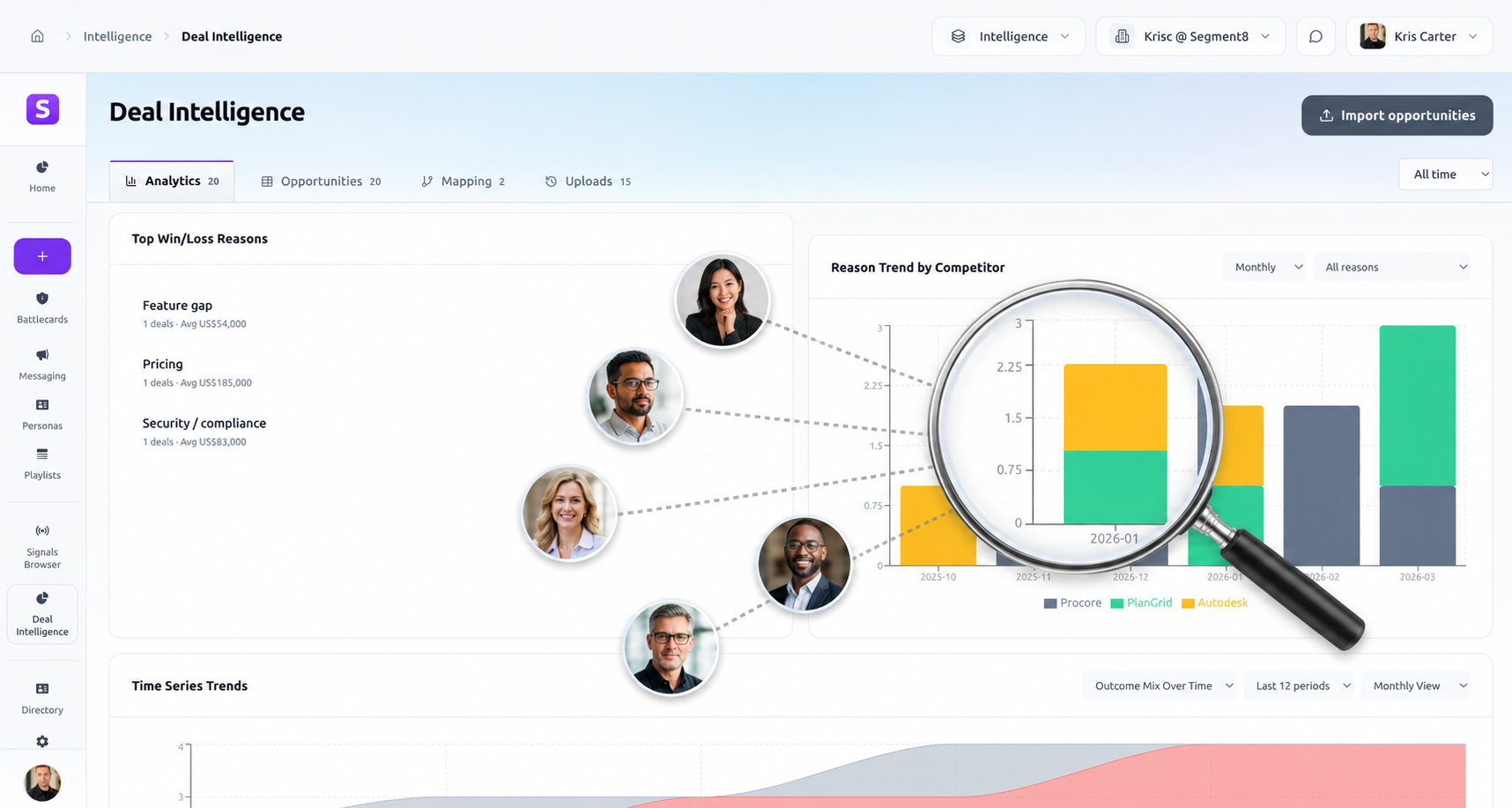
The launch extends Segment8’s GTM Intelligence Platform from static competitive enablement into continuous market awareness. Market Signals feeds the intelligence layer that informs battlecards, sales plays, win-loss analysis, and deal strategy. Instead of treating competitive intelligence as an episodic research task, Segment8 gives revenue teams a live system for market response.
"Competitive intelligence used to rely on the discipline of the person doing the monitoring," Carter added. "That does not scale. Revenue teams need a system that watches the market, classifies what changed, and routes the signal to the people who can use it. That is what Market Signals brings into Segment8."
Market Signals is part of Segment8’s broader move toward continuous GTM intelligence, where market signals, battlecards, win-loss evidence, and deal context reinforce one another. The goal is to help revenue teams move from reactive competitive updates to a more structured operating model: see what changed, understand why it matters, and update the field before the next competitive conversation.
Revenue teams can request a demo at segment8.com/demo.
About Segment8
Segment8 is the GTM Intelligence Platform for revenue teams competing in active markets. It connects market signals, win-loss intelligence, and field enablement in one platform so market intelligence reaches sellers before the deal is decided. Based in Manchester, UK.
Media contact
Kris Carter
Founder, Segment8
[email protected]