Once upon a Klue: a feed is not a response plan
Your competitor launches a new package at 9:14am. By 9:27am, somebody has posted the link in Slack with three pairs of eyes and the word “thoughts?” That is usually where the process ends.
But the alert is only the opening scene. Does the new package show up in deals? Do buyers care? Does the battlecard need new proof? Does the launch message now look a little optimistic? Those are product marketing jobs, and they need an owner, a decision and a finished answer for Sales.
Segment8 puts the source, deal evidence, buyer research, messaging, battlecards, launch work and approval in the same place. Your team can follow a finding all the way to the seller answer. Slack can go back to being Slack.
Start with a source your team can check
A headline can tell you that something happened. It rarely gives you everything you need to write a useful response. Your team needs to open the source, read the claim and understand which product or buyer it affects.
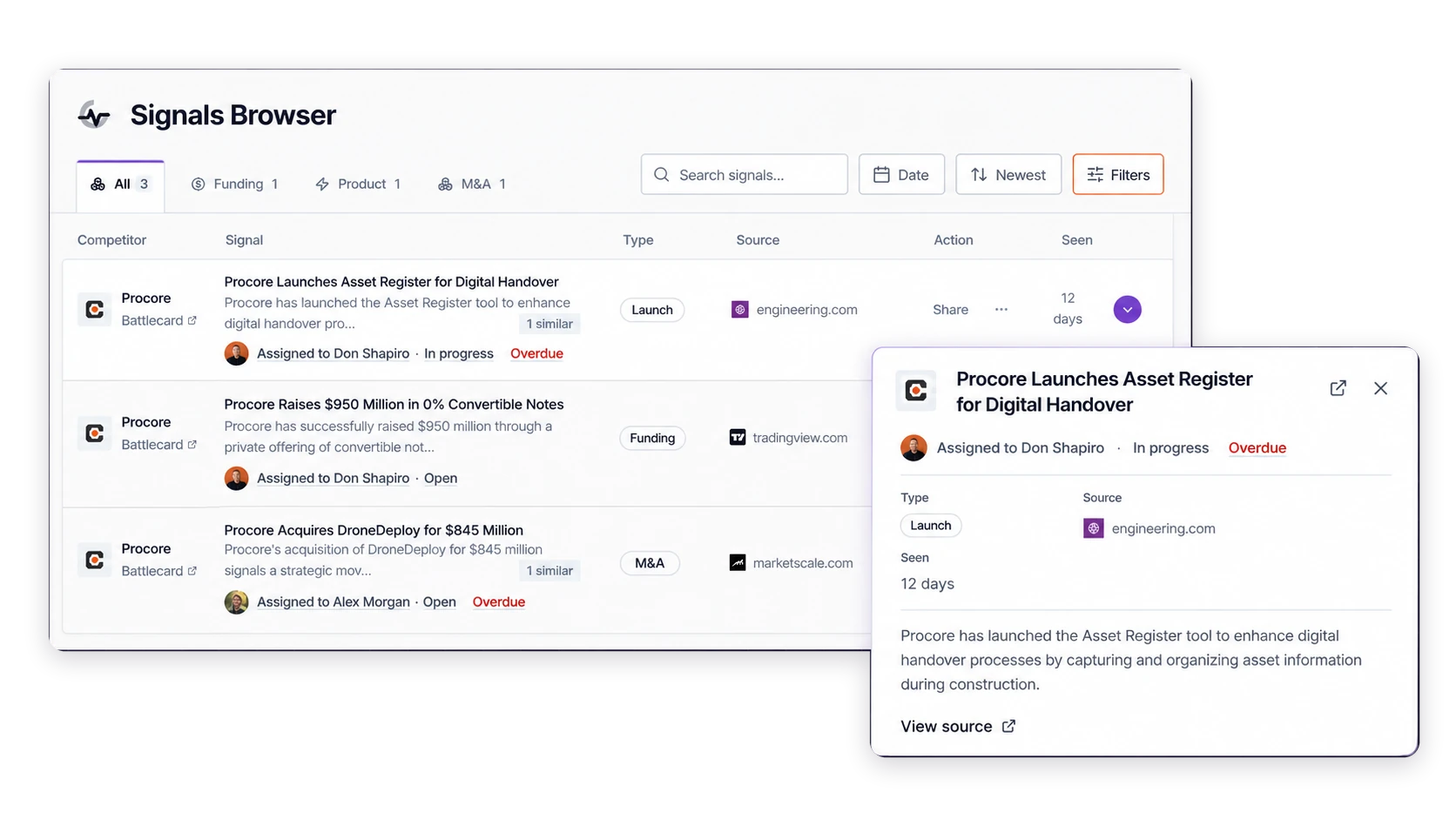
Segment8 follows approved news and specialist sources, along with selected competitor pages. It turns captured activity into Signals, which are market findings with the source and competitor information attached. You can filter them by competitor, type and date range. That helps you find the evidence for the question you are working on.
The source stays useful after the research is done. If you ask a colleague to update a battlecard, they can read the material that prompted the request. They start with the evidence and a clear question. They do not have to hunt through messages to work out why the update matters.
Read about competitor monitoring in Segment8.
Find out where a competitor matters in your deals
The competitor making the most noise may not be the one costing you the most business. To choose the right work, Product Marketing needs to look at what is happening in deals as well as what is happening in the news.
Segment8 brings in deal records from HubSpot or a CSV file. You choose the fields, check a preview and review the records before using them. You can compare wins and losses, deal counts, deal values and recorded loss reasons. Filters help you look at a particular competitor, period, outcome or deal size.
This gives your research a clearer purpose. Instead of asking for a general competitor update, you can ask why a certain group of deals is being lost. You can also group different names for the same competitor, so spelling differences do not split the evidence into separate groups. The team has a more useful starting point for deciding what to investigate next.
Ask buyers what influenced their decision
A CRM loss reason tells you what your team recorded. A buyer's answer tells you how they describe the decision. Both are useful, and they can point in different directions.
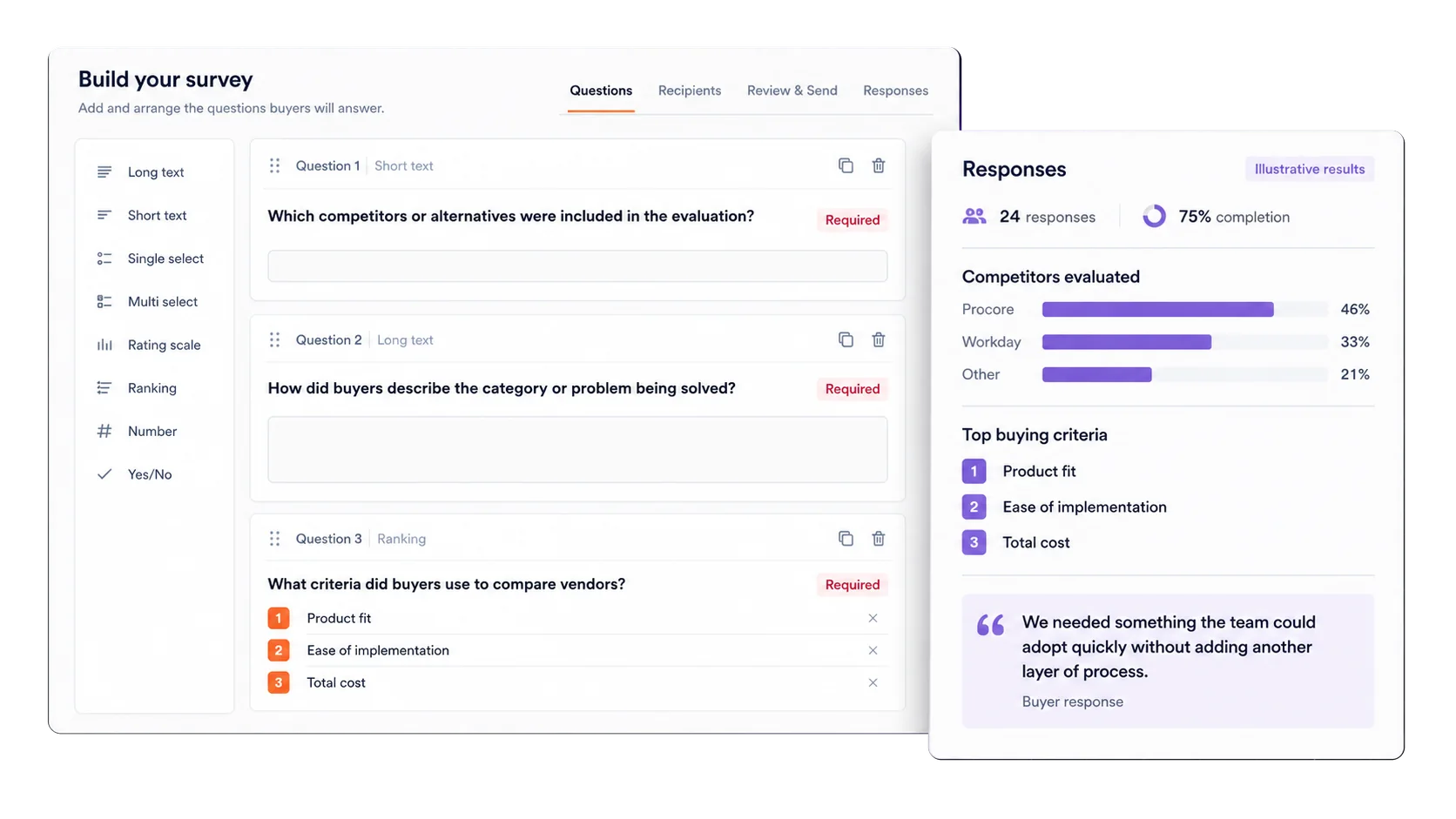
Segment8 supports structured win-loss surveys. Your team can write the questions, choose a group of participants, send individual invitations through the survey delivery workflow and review the answers by question. You can look at those responses beside the deal results while keeping the two sources separate.
Suppose a deal was marked as lost on price. The buyer may explain that they could not see enough value in the package, or that a requirement was missing. That gives Product Marketing a more specific problem to solve. The response might need better proof, a clearer message or more research. You can base the next assignment on what you learned instead of simply repeating the CRM label.
Read about win-loss analysis and buyer research.
Choose the work that will help the team
Once you have the market finding, deal results and buyer feedback, the next question is practical: what should your team do about it? A useful research process ends with a decision about the work.
Segment8 gives you the records needed to make that decision. You might update one objection response in a battlecard. You might change the proof used for a buyer group. A larger finding could affect positioning, a persona or the message in a launch plan. The size of the response should fit the evidence and the question your team needs to answer.
This helps Product Marketing explain its priorities. You can show the finding, the business question behind it and the output you want to prepare. The person receiving the work knows what to do and why it matters. The manager can follow the response instead of seeing only a list of research activities with no clear result.
Write a battlecard a seller can use
A seller opens a battlecard because they need help with a real conversation. They need the objection, the answer and the proof behind it. They should not have to turn a long research note into a response while a buyer waits politely on the other end of the call.
Segment8 has built-in competitive battlecards for that work. Your team can keep objections, proof and seller guidance together. Positioning and messaging explain the wider product story. Buyer personas help you understand what the person on the other side of the conversation cares about.
Take a buyer comparing your product with a competitor's new package. The owner can check the announcement, review the deal and buyer evidence, then prepare the answer. The battlecard gives Sales the response. The related research gives Product Marketing the basis for checking and maintaining it. When the market changes again, the team knows which content and owner to involve.
Give the response a clear owner
A finding can create several jobs at once. The battlecard needs an update. The launch message needs a review. A product specialist needs to check the proof. If the request goes to everyone, it belongs to no one, which is a very efficient way to ensure it lives forever in a thread.
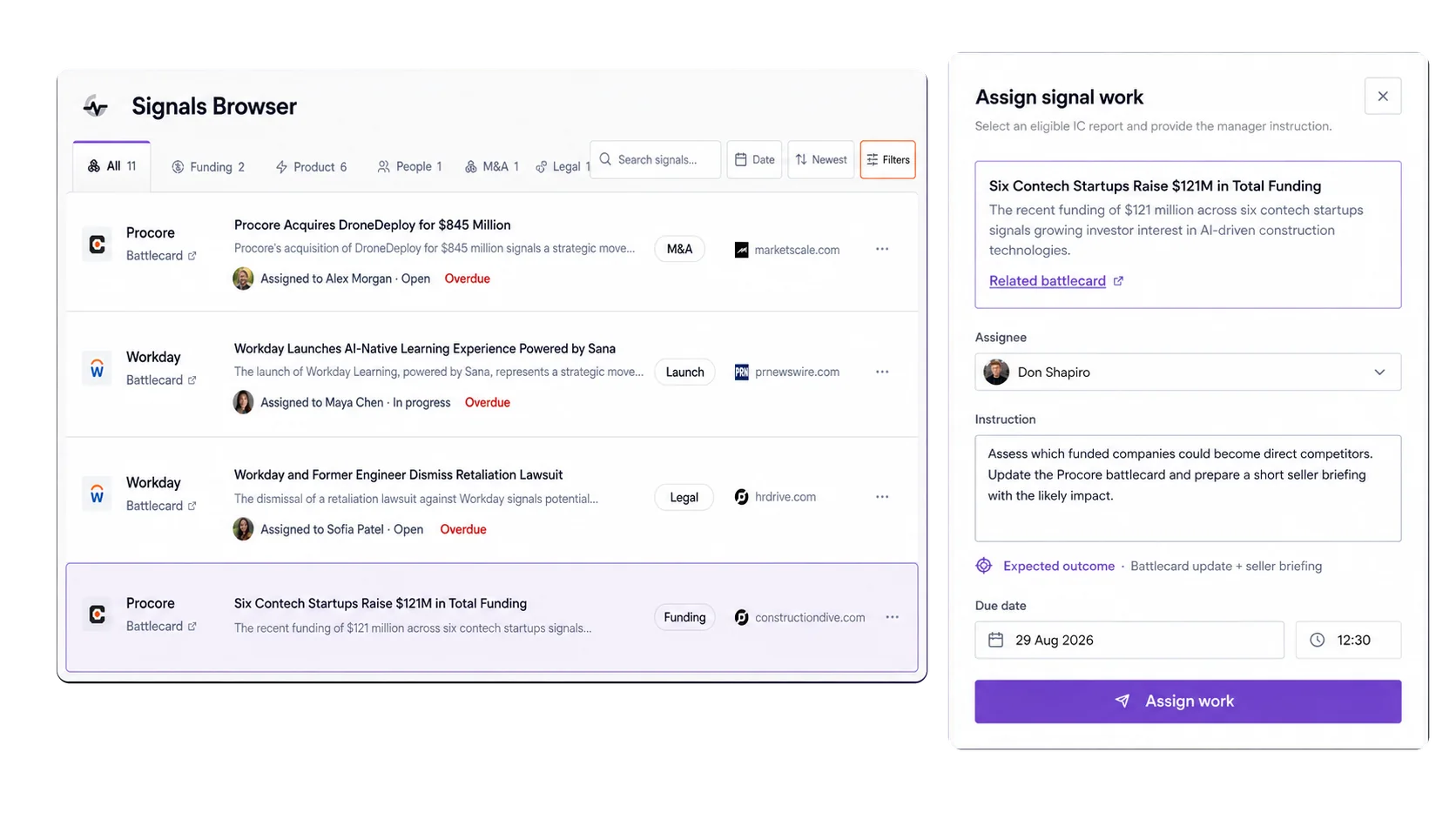
Segment8 lets you turn a selected Signal into a work assignment for a manager or team member. Add an instruction and a due date. The owner stays clear, and collaborators can help prepare the work. Progress is visible as the response moves forward.
A useful instruction names the result you need. For example, ask the owner to check a competitor claim and revise the matching objection response. The source explains what prompted the work. The instruction explains what the person should produce. That gives your team a more direct route from research to a finished answer.
Get the answer reviewed before Sales uses it
Competitive guidance includes claims that sellers will repeat to buyers. Your team needs a clear way to review those claims and record the decision. Segment8 makes approval part of the work.
The approval view shows the content version, the reviewers and the progress of the review. A reviewer can approve the content or ask for changes, with notes explaining the decision. The owner can see what needs attention and who is responsible for the next step.
Managers can choose the approvers and set whether everyone must approve or whether a set number of approvals is enough. They can also require another review after edits. Segment8 shows when content has changed since approval. The history keeps the decisions and handoffs, so the team can understand what was reviewed and what happened next.
This gives the seller's answer a clear path through preparation and review. Product Marketing can share it with a record of the people and decisions behind it.
Read about battlecards, assignments and approvals.
Carry the same learning into your launch
A competitor's move can affect more than today's sales conversation. It may change how you explain a product that is about to launch. Segment8 keeps launch planning alongside the research and guidance, so your team can coordinate both responses.
A launch plan connects the audience, message, owners, dates, assets and measures. Workstreams and milestones help the team organise what needs to be ready. If a finding affects the launch, the owner can identify the content that needs review and assign the work to the right people.
That keeps the launch message and the competitive answer tied to the same decision. Your team can prepare the battlecard, messaging and supporting material together, review the guidance and package the approved items for Sales. The finding becomes part of the launch work rather than an alert that each team has to interpret on its own.
Follow one competitor announcement through the process
Imagine a competitor releases a new bundle aimed at your main buyers. Product Marketing opens the source and checks what is included. The team looks at the relevant deals and buyer responses to understand the questions the new offer raises.
The battlecard owner prepares an answer with proof. The messaging owner reviews how the difference should be explained. If a launch is affected, its owner identifies the assets and dates that need attention. Each person has a job to finish, and each job is tied to the same evidence.
The battlecard then goes through approval. A reviewer may ask for a more precise claim or stronger proof. The owner makes the change and follows the review to completion. Your team can package the approved material for the sellers who need it.
At the end, Sales has a prepared answer. Product Marketing can still show the source, the reason for the update and the people who reviewed it. That is the connected competitive response Segment8 brings together.
Get the guidance to the right sellers
The work is useful when the people handling deals can get to the answer. Segment8 supports guidance in the product, email and connected working channels. You choose the seller audience while keeping editing and publishing rights with the people who maintain the content.
Playlists let you put approved guidance and exports together for a product, competitor or launch. A seller can receive the battlecard and supporting material as one collection. Answers in enabled channels can also point to source evidence when someone needs more detail.
Email delivery status shows whether a message was accepted, delayed, bounced, failed or suppressed. The people managing the send can see what happened. Product Marketing has a route from preparing the answer to sharing it with the intended team, with responsibility for the content kept clear.
Read about sales guidance and delivery.
Keep the programme moving from week to week
The same process can guide your regular competitive review. Look at the findings that matter to your products, the new deal evidence and the buyer questions still open. Decide which responses deserve work, then check the progress of the assignments already in place.
Segment8 gives that discussion something concrete to work from. The manager can see the team's work. The owner can point to the source and explain the requested change. A reviewer can see the content version and the decision needed. The discussion can focus on finishing the response instead of finding out where the work has gone.
Keep the roles clear as more people become involved. The owner is responsible for the content. Collaborators help prepare it. Approvers review it. The seller audience uses the approved answer. Segment8 keeps those roles separate, so making guidance available to more people does not make responsibility for it less clear.
This is especially useful when one competitive programme supports several products or launches. The team can use the same way of assigning and reviewing work while preparing different answers for different buyers. A new finding enters a process people already understand. It has somewhere to go, someone to act on it and a useful result the rest of the business can see.
Choose a system for the whole competitive job
Klue's current platform includes competitive intelligence and win-loss. Segment8 makes its case through the work connected to that evidence: positioning, personas, battlecards, assignments, approvals and launch plans. Those are the jobs Product Marketing needs to complete when the business must respond.
Bring a competitor, a sample of relevant deals and a battlecard that needs a change to a demo. Follow the source into the analysis, give the response to an owner and open the approval view. Then look at the final guidance as a seller would.
That shows the value in terms of work your team can finish. You can see what changed, why it matters, who owns the response and which answer is ready for Sales. Request a Klue alternative demo around the competitive question your team needs to answer next.
Klue alternative FAQs
Segment8 brings competitor findings, deal results and buyer feedback into the same place as your messaging and battlecards. Your team can investigate a question, decide what needs to change, assign the work and get the answer approved before sharing it with Sales.
Yes. Segment8 has built-in battlecards for objections, proof and seller guidance. The content has an owner, people who can help prepare it and a defined seller audience. Your team can review and maintain the answer alongside the evidence behind it.
Segment8 follows approved news and specialist sources, plus selected competitor-owned pages. Captured findings keep the original source and competitor details. Your team can filter them, inspect the material and turn a relevant finding into a clear assignment.
Choose the reviewers and the approvals needed. Reviewers can approve or ask for changes, with notes kept for the owner. Segment8 shows the content version and review progress. Managers can require another approval after edits, and the history keeps the decisions and handoffs.
Bring in the relevant deals, map the fields and check the preview. You can compare wins, losses, deal values and recorded reasons alongside market evidence. That helps Product Marketing choose a specific research question or content update with a clear business reason.
The CRM shows what your team recorded. A survey gives the buyer a chance to explain the decision directly. Segment8 keeps the two accounts separate so you can compare them and use the differences to guide research, messaging and proof.
Yes. A selected Signal can become an assignment for a manager or team member. Add an owner, instruction and due date. The person doing the work can see the source and understand the result needed, such as checking a claim or revising an objection response.
A persona records buyer problems and needs. That helps Product Marketing choose the message and proof for the person Sales is speaking to. Segment8 connects persona work to the guidance, so the answer can fit the buying situation rather than use the same emphasis for everyone.
Yes. Your team can use the finding to review positioning, messaging and launch work. The launch plan connects the audience, owners, dates and assets. Assign the changes, review the guidance and package the approved material for the sellers who need it.
Your team chooses the relevant competitors, adds product knowledge, checks the deal data and reviews the findings. People decide what to say and who should receive it. Segment8 keeps those jobs connected and makes responsibility clear as the work moves forward.