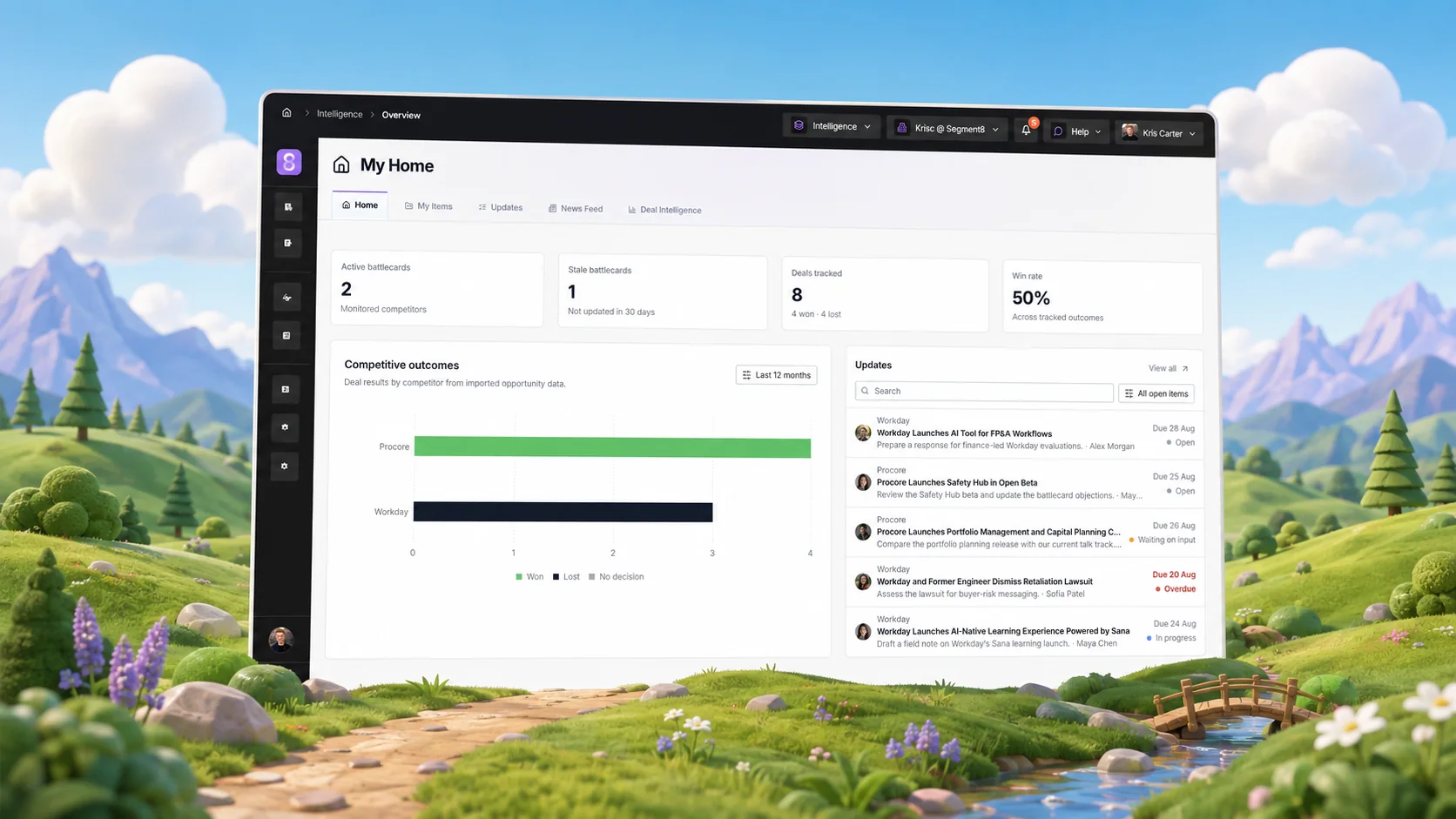
What is a Go-To-Market Platform?
A Go-To-Market Platform connects market activity, commercial evidence, GTM work and the people responsible for acting on it. It is where the separate systems finally compare notes.
Most GTM software is organised around one function. Competitive intelligence tools monitor competitors. Revenue intelligence tools analyse calls and pipeline. Enablement platforms distribute content. CRMs manage customer and deal records. The context between them is usually left for Product Marketing to join together by hand, which is an expensive use of a human being.
A Go-To-Market Platform provides that connected layer. Market changes connect to buyer evidence and deal outcomes. Those findings connect to positioning, launches, battlecards and seller guidance. The teams that need to act can see the same context without rebuilding it from a scavenger hunt.
This is different from the increasingly common use of “GTM platform” to describe prospecting and outbound software. Here, Go-To-Market Platform means the system connecting market, buyer, deal and product activity to the teams and workflows responsible for acting on it.
A place for strategy and execution to stay connected
It replaces manual handoffs between market monitoring, CRM analysis, GTM coordination, and field delivery.
The platform brings together competitor activity, CRM outcomes, win-loss feedback and product context. Teams use this information to update positioning, launch plans, battlecards and seller guidance.
Without this connection, a pricing change becomes only an alert. A repeated loss reason stays in the CRM. Buyer feedback stays in a research report. The next seller still uses old guidance.
A Go-To-Market Platform keeps the source, context, decision and approved response connected. Leaders can see what needs action. Sellers get the result before the next customer conversation.
It does not try to become another CRM, call recorder or content library. Those systems remain useful systems of record. The Go-To-Market Platform connects their GTM context to the decisions and work happening across the organisation.
Why the GTM response breaks down
Your teams often have the evidence they need. The challenge is keeping it available as they agree a direction, make plans and prepare the message customers will hear.
GTM work breaks between teams and tools
Competitive intelligence monitors the market. RevOps owns CRM data. Product marketing owns positioning and launches. Enablement owns seller content. Sales owns the customer conversation. The work breaks down between these owners.
This failure has a direct cost. Win-loss research identifies an objection but the battlecard stays unchanged. A competitor launch is reported but no one connects it to the deals it affects. CRM analysis shows a weak segment but the message stays the same. Sellers encounter known problems because the evidence and response live in different places.
Meetings, Slack and shared documents can distribute information. They do not maintain the connection from source to decision to action. A Go-To-Market Platform becomes useful when manual handoffs create old guidance, repeated research, slow responses or launches based on stale market context.
Benefits of a connected platform
| Outcome | How the platform helps |
|---|---|
| Respond while deals remain open | Connect an important market change to affected opportunities and reviewed guidance before the next call. |
| Stop repeating known losses | Connect repeated loss reasons and buyer objections to positioning, proof and qualification guidance. |
| Keep launches current | Give launch teams the competitor, buyer, deal and product context already known elsewhere in GTM. |
| Give sellers relevant guidance | Connect sellers to the position, proof and objection response relevant to their account. |
| Keep evidence attached | Preserve the source and context behind important GTM decisions and guidance. |
| Connect action to outcomes | See what changed, what the team did about it and what happened in later deals. |
What the platform must connect
The defining feature is not how much information the platform collects. It is whether information in one part of GTM can change work in another.
The platform does not need to replace every system used by sales, marketing and product. It needs a shared model of the companies, accounts, opportunities, buyers, products, messages, evidence and teams involved.
| Component | What it connects |
|---|---|
| Market and competitive intelligence | Collect market and competitor activity, retain the source and connect important changes to the teams and decisions they affect. Explore Competitive Intelligence → |
| Deal intelligence | Connect CRM outcomes with competitors, segments, loss reasons and wider market context. Explore Deal Intelligence → |
| Win-loss intelligence | Connect buyer and seller explanations to the opportunity, market picture and GTM response. Explore Win-Loss → |
| Positioning and launches | Connect current market, buyer, deal and product context to positioning, messages and launch decisions. Explore Launch Planning → |
| Field guidance | Turn those decisions into battlecards, objection handling and guidance sellers can use. Explore Battlecards → |
| Governance and review | Keep evidence, owners, decisions, approvals and later outcomes connected. Review AI and data use → |
Prospecting databases, outbound sequencers and marketing automation platforms help companies find and contact buyers. A Go-To-Market Platform solves a different problem: connecting what the organisation learns with what its GTM teams do next.
Five tests for a real platform
A product is not a Go-To-Market Platform because several GTM features have been bundled together. The test is whether those capabilities actually share context.
| Test | What to verify |
|---|---|
| It connects external and internal activity | Market changes, buyer feedback, CRM outcomes and company context can inform the same decision. |
| It connects evidence to deals | Teams can see where competitors and market changes intersect with accounts, opportunities and outcomes. |
| It changes GTM work | Findings can update positioning, messaging, battlecards, launch plans and seller guidance. |
| It reaches the right teams | Relevant people see what changed and what they need to do without reconstructing the context themselves. |
| It learns from outcomes | Later deal outcomes feed back into the same connected picture. |
A competitive alert feed does not pass these tests if the work ends when the alert is delivered. Neither does a content library that distributes battlecards without understanding the evidence that should change them. A CRM remains a system of record rather than the operating layer connecting these decisions.
The distinction is the connection. A Go-To-Market Platform maintains the relationship between what happened, what the organisation knows, who needs to care and what should happen next.
Four workflows it should support
The value becomes clear when something changes and several GTM teams need to respond.
| Trigger | Connected response |
|---|---|
| A competitor changes pricing |
|
| A loss reason repeats |
|
| A product is preparing to launch |
|
| A strategic deal needs support |
|
Each workflow crosses several teams. Competitive intelligence may identify the trigger. RevOps provides deal context. Product marketing decides what changes. Enablement and sales take the response into the field. The platform keeps the context connected as ownership changes.
How a Go-To-Market Platform works
The platform uses a simple loop: connect GTM activity, understand what changed, decide what matters and put the answer to work.
1. Connect market, buyer, deal and product activity
External information includes competitor and market activity. Internal information includes CRM outcomes, win-loss responses, product context, company guidance and field observations.
These sources answer different parts of the same question. A competitor announcement shows what changed. CRM data shows where it may be affecting outcomes. Buyer feedback explains the decision. Product context determines the response available to the company.
2. Understand what changed
The platform organises this activity around shared GTM entities such as companies, markets, accounts, opportunities, products and buyers. Teams can see where they win and lose, which competitors appear, which objections repeat and which market changes need attention.
The point is not another dashboard. It is one platform that keeps the evidence, GTM work, and people responsible for the response connected.
3. Decide what to do
Findings can change positioning, messaging, buyer personas, launch plans, battlecards, objection handling and sales plays. The evidence behind the decision stays connected to the resulting work.
A loss trend therefore does not have to end as a chart in a quarterly review. It can become a revised competitive response, a launch decision or new guidance for the next group of affected deals.
4. Connect the right teams
Different teams need different outputs from the same change. Leadership may need the commercial implication. Product marketing may need to change positioning. Enablement may need to update guidance. A seller may need an objection response for tomorrow's call.
The platform connects each team to the part it needs while preserving the shared context behind it.5. Learn from the next outcome
Later deal outcomes return to the same connected system. Teams can see whether the market has moved again, whether the original pattern continues and whether guidance needs another update.
Why fragmented tools leave the response unfinished
A point tool can capture one part of the story. The response is still unfinished until the evidence changes a decision, an owner moves the work and Sales gets the approved answer.
CRM data needs GTM context
A CRM records accounts, opportunities, activity and outcomes. It tells the organisation what happened in pipeline. A Go-To-Market Platform connects those outcomes to market movement, buyer explanations, positioning decisions and the response used in subsequent deals.
Market signals need a next action
Competitive intelligence software monitors competitors and maintains competitive content. A Go-To-Market Platform includes competitive intelligence as one input, then connects competitor activity to CRM outcomes, buyer feedback, product context, launches and seller guidance.
Deal evidence needs a product response
Revenue and conversation intelligence platforms analyse pipeline and customer conversations. They provide valuable evidence about deals and buyers. A Go-To-Market Platform connects that evidence to the wider market picture and the GTM work it should change.
Enablement needs the decision behind the content
Enablement platforms distribute content, training and coaching. A Go-To-Market Platform operates further upstream and across the organisation: it connects the evidence and decisions that determine why guidance needs to change in the first place.
Documents need ownership and review
Knowledge tools are flexible places to write and store company information. A Go-To-Market Platform models the relationships between GTM activity, evidence, decisions, teams, assets and outcomes rather than treating each as another document.
| System | Primary record | Question it answers | Where the GTM Platform continues |
|---|---|---|---|
| CRM | Account and opportunity | What happened in pipeline? | Connects outcomes to market, buyer and product context. |
| Call intelligence | Recorded conversation | What was said? | Connects conversation evidence to wider GTM activity and decisions. |
| Competitive intelligence | Competitor and signal | What changed in the market? | Connects the change to deals, buyers, launches and seller guidance. |
| Enablement | Content and training | What should sellers access or learn? | Connects guidance to the evidence and decisions that produced it. |
| Knowledge base | Document | What has the company written down? | Connects evidence, decisions, teams, assets and outcomes as structured GTM context. |
Who uses it
A Go-To-Market Platform is for growing companies where market activity, deal volume and team boundaries make GTM increasingly difficult to coordinate by hand.
Revenue executives
CROs and revenue leaders need a shared view of what is changing across the market and their revenue organisation. The platform connects market movement, buyer explanations, pipeline outcomes and the actions teams are taking in response.
Product marketing and competitive intelligence
Product marketing needs to turn market and buyer understanding into positioning, launches and seller guidance. Competitive intelligence becomes part of this wider workflow rather than a separate destination for competitor information.
Sales enablement and sales leadership
Enablement and sales leaders need guidance that reflects what the organisation currently knows. The platform connects changes in the market, buyer behaviour and company response to the guidance sellers use.
Revenue operations
RevOps owns much of the structure behind GTM outcomes. A Go-To-Market Platform connects that deal context to competitor activity, buyer evidence and the decisions made elsewhere in GTM without trying to turn the CRM into a market-intelligence system.
Product and launch leaders
Product and launch teams need current buyer, competitor and commercial context when deciding how to take products to market. The platform connects that context to positioning, field readiness and the teams responsible for execution.
A strong sign that a company needs a platform is repeated information without coordinated action. The same competitor surprises sellers. The same loss reason appears each quarter. Teams repeat research for each launch. The information exists. The connection does not.
How to choose one
Test whether the platform can take a real change in your GTM environment and connect it to the teams, decisions and work that should respond.
Ask what evidence the platform can combine
Look beyond the number of integrations or data sources. Check whether competitor activity, CRM outcomes, buyer feedback, product context and internal guidance can become part of the same GTM picture.
Ask how it finds what affects deals
A competitor alert is useful when the organisation can see which products, segments, opportunities, messages and teams it affects. Ask whether that context survives as the information moves from one team to another.
Ask what users can change
A dashboard can identify a trend without changing execution. Check whether findings can update positioning, battlecards, launch plans, personas, objection handling and seller guidance.
Ask how guidance reaches the field
Different teams should not need to learn another research system to understand what changed. Check whether each team can see the context, decision and next action relevant to its work.
Ask what the platform connects
Your CRM, market intelligence and specialist tools keep the records they already own. Segment8 connects those records to the decisions, owners, approvals and guidance that move GTM work forward.
| Buying checklist |
|---|
| Can market changes connect to the deals, products and teams they affect? |
| Can CRM outcomes connect to competitor, segment and buyer context? |
| Can buyer feedback change positioning, launches or guidance? |
| Can teams see the evidence behind an important GTM decision? |
| Can one finding produce different actions for different teams? |
| Can sellers receive current guidance without rebuilding the context? |
| Can owners see when underlying evidence has changed? |
| Can the company start with one workflow and expand across GTM? |
How to start
Start with one repeated GTM problem where several teams already have pieces of the answer. Prove the connection, then expand.
1. Choose one costly problem
Select a question with a clear owner and commercial consequence. It might be why a segment is losing, how a competitor is affecting late-stage deals or why sellers repeatedly encounter the same objection.
2. Connect the minimum useful evidence
Bring together the relevant competitor activity, CRM outcomes, buyer evidence, product context and existing guidance. Add enough to understand the problem rather than attempting to centralise every piece of company information.
3. Define ownership and approval
Identify who needs to understand the change, who decides the response and which teams need the result. The platform should make those relationships explicit rather than relying on another manual handoff.
4. Update one sales asset
Update the positioning, battlecard, launch plan, objection guidance or sales play affected by the finding. Keep the evidence and decision connected to the resulting work.
5. Review the next cohort
Bring later deal outcomes and market activity back into the same connected system. The organisation can then see whether the pattern continues and what needs to change next.
Useful measures include time from an important change to team action, competitive win rate, repeated loss reasons, guidance freshness, seller access and the amount of duplicated GTM work. The objective is to shorten the distance between knowing something and doing something about it.
Why the connected layer matters
Segment8 connects the GTM activity and decisions that otherwise stay split across specialist systems and documents.
Your CRM can remain the record for accounts and opportunities. Other systems can keep their specialist records. Segment8 connects the market change to the deal, the buyer evidence, the decision and the guidance that follows.
The point is not another place to store a document. The point is a connected response that shows what changed, who owns the work, what was approved and which sellers need the answer.
The need grows as GTM activity, specialisation and team boundaries make shared context harder to maintain. Segment8 gives the team a product for that work before it becomes a collection of manual handoffs nobody can see.
Common questions
A GTM operating system describes how the organisation runs its go-to-market. A Go-To-Market Platform is the software layer connecting the information, decisions, teams and workflows used to run it.
No. The CRM remains the system of record for accounts, opportunities and pipeline. The Go-To-Market Platform connects relevant CRM outcomes with market, buyer and product context and the teams responsible for acting on it.
Go-to-market software is a broad label covering tools for prospecting, engagement, CRM, enablement and analytics. A Go-To-Market Platform connects activity across GTM so a change in one area can inform decisions and work elsewhere.
No. A GTM stack is the collection of tools used across sales, marketing and revenue operations. A Go-To-Market Platform connects GTM activity across those tools and teams.
Market and competitive intelligence, deal intelligence, buyer and win-loss evidence, product context, governed GTM work, field guidance and outcome review.
Revenue executives, product marketing, competitive intelligence, enablement, RevOps, product and sales leaders use different views of the same connected GTM picture.
Start with one costly repeated problem where the information already crosses teams, such as losses to a competitor. Connect the evidence, decision and resulting guidance before expanding.
Measure how quickly important changes produce action, whether repeated problems decline, whether guidance stays current and whether teams spend less time rebuilding context that already exists elsewhere.
AI helps companies process more GTM activity and turn context into useful work. The advantage comes from connecting that intelligence to the organisation, so the right teams know what changed and what to do next.
Segment8 connects external market activity with CRM outcomes, models real GTM work and relationships, surfaces intelligence suggestions, and delivers approved guidance where Sales works.
Request a product demo at segment8.com/demo to see how Segment8 connects your GTM activity with the teams that need to act.