The alert arrived. Now the actual work starts.
A competitor changes its pricing. Another releases a feature. A third discovers a fresh adjective for the same old message. Your team wants to know about these moves, but knowing is only the first part of the job. Someone still has to decide whether the change matters and what Sales should say about it.
Segment8 keeps that response connected to the research. It brings sourced market findings together with deal results, buyer feedback, messaging, battlecards and launch plans. Your team can investigate a finding, assign the work, review the answer and share the approved guidance with the people who need it.
That is the reason to consider Segment8 as a Crayon alternative. The team gets a place to follow a market change through to a useful business response. The source stays with the work, the next action has an owner and the seller receives an answer prepared for the situation. No ceremonial forwarding of the alert required.
Keep the source behind the finding
An alert is more useful when the person reading it can check the original material. Product Marketing needs to know what the competitor said, which product it concerns and what was actually announced. A screenshot in a Slack thread is not a source strategy. Those details matter when the team prepares a claim for Sales to repeat.
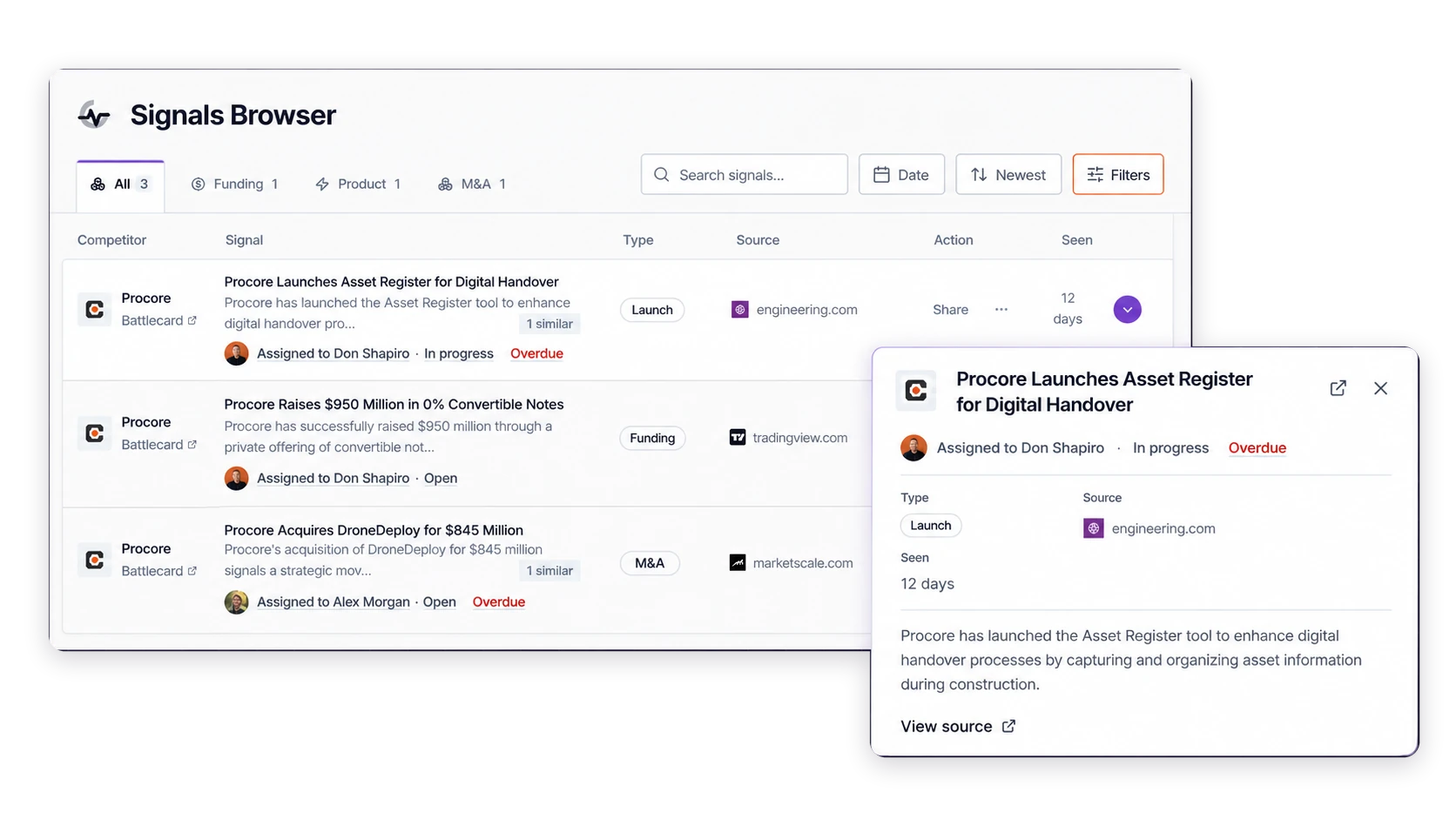
Segment8 follows approved news and specialist sources, plus selected competitor-owned pages. Captured activity becomes a Signal with its source and competitor information attached. Your team can filter the findings by competitor, type and date range. Repeated coverage can be grouped around the market event.
This gives colleagues a shared starting point. The researcher can identify the event, the product specialist can help explain it and the content owner can prepare the response. Each person can inspect the source instead of working from a shortened summary passed through several messages.
Read about competitor monitoring in Segment8.
Follow sources that answer your business questions
Different sources help with different questions. A release page can explain a new capability. A company announcement can describe a package change. Specialist reporting can give the team more detail about the market buyers are considering.
Start with the competitors and product questions that matter to your business. Segment8 brings approved sources into the same Signal workflow while keeping the original material available. Filters help the team find the evidence for the question at hand, whether that is a new offer, a product change or a message aimed at one of your buyers.
That makes research easier to use in the next task. An owner asked to revise a battlecard can see which source to check and which claim needs attention. A launch owner can see the event behind a proposed message change. The research is attached to a question the team needs to answer.
Decide which market change deserves work
The loudest competitor is not always the one affecting your most important deals. A busy news feed can make every announcement look urgent. Product Marketing needs another way to choose which response should come first.
Segment8 adds deal results to the decision. Bring in HubSpot records or a CSV, map the fields and look at the relevant competitor, period and deal group. Compare wins, losses, deal counts, values and recorded loss reasons. Direct buyer feedback from structured surveys gives the team another source of evidence about what mattered.
The result can be a more specific assignment. Your team might need to investigate a packaging concern, improve the proof in an objection response or change the message for a launch. You can explain why that work matters instead of treating every alert as an equal request for time.
Work out what the finding means for your message
A competitor announcement tells you what that company wants buyers to understand. Your response needs to explain what the difference means for the products and buyers you serve. Segment8 connects the source with the evidence and content your team uses to make that decision.
Suppose a competitor announces a lower-priced package. Read what is included, then look at the deals where the offer is relevant. Buyer feedback may help explain whether the concern is budget, value, a missing requirement or something else. That gives the content owner a clearer question to answer.
The team can then decide what proof and message will help. The assignment might be to explain a capability difference or make the value of a package easier to understand. The source stays available while Product Marketing develops and reviews the response.
Read about deal results and buyer research.
Put the answer in the content it changes
Segment8 has built-in battlecards, positioning and messaging, buyer personas and launch plans. These give Product Marketing places to act on what it learns. An objection response belongs in a battlecard. A change to the product story belongs in messaging. A finding about buyer needs can help the team revise a persona.
One market event may affect several of those items. A new competitor offer could change both an answer used in current deals and the message for an upcoming launch. The team can prepare those responses around the same evidence while giving each piece of work an owner.
Sales receives the prepared answer. Product Marketing keeps the research and responsibility behind it. When a later finding changes the situation, the team knows which content needs review and who should be involved. The work continues in the same place where the guidance is maintained.
Make the next action clear
A useful assignment tells someone what to produce and why. A message saying that a competitor has changed its website leaves a lot for the recipient to work out. A request to check a named claim and revise the matching objection response gives them a clear job.
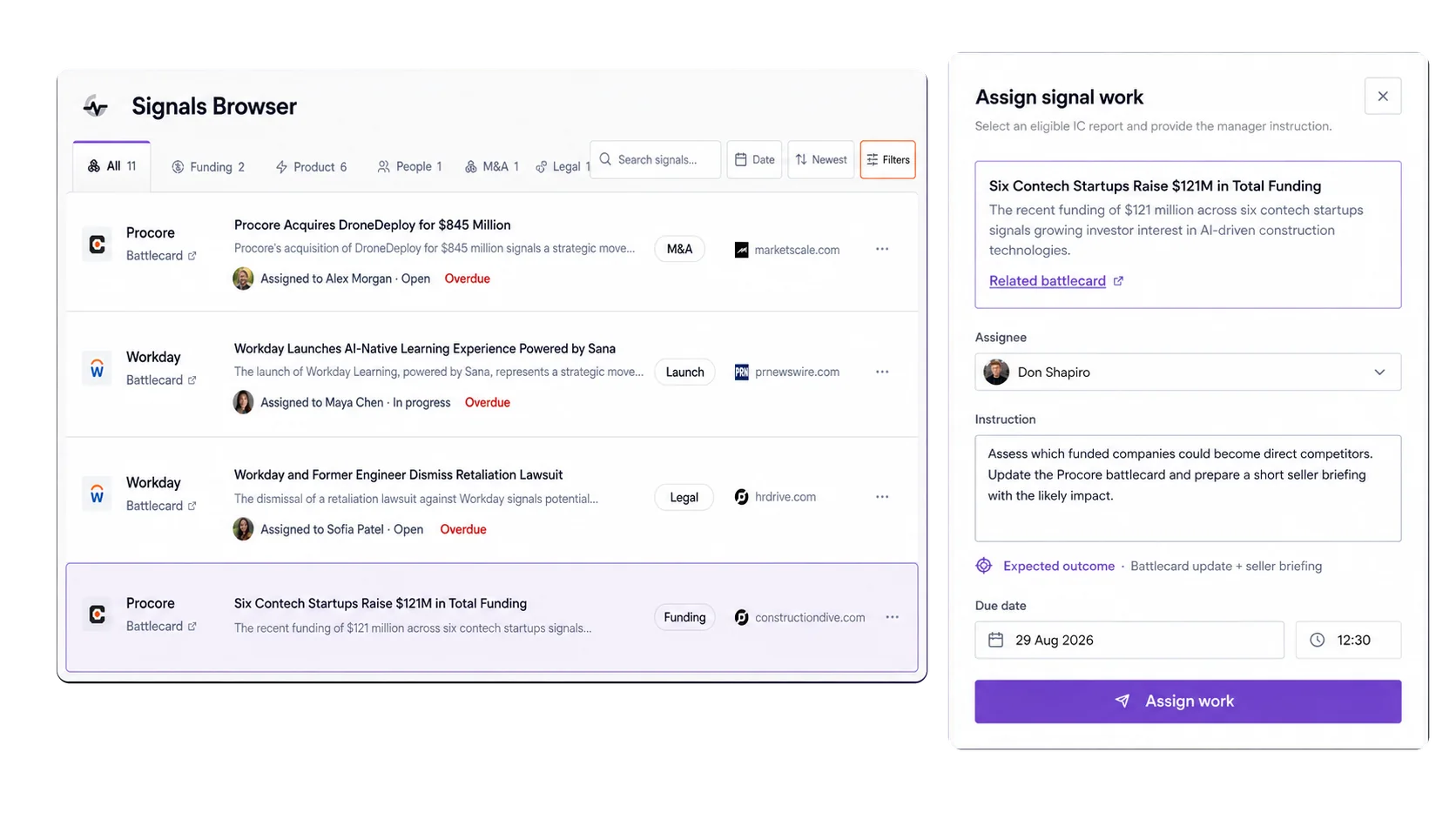
Segment8 lets a selected Signal become an assignment for the responsible manager or team member. Add an instruction and due date, keep the owner clear and bring in collaborators to help. Progress remains visible as the response moves forward.
The source explains what prompted the request. The instruction explains the result needed. The owner can work on the relevant message, battlecard or launch item without first rebuilding the brief. This is how a market finding becomes work the team can manage and finish.
Review the claim and proof before sharing the answer
The team needs to check the answer before it becomes guidance for Sales. Segment8's approval workflow shows the content version, reviewers and progress against the required approvals. The owner can see which action is next and who is responsible for it.
A reviewer can approve the content or request changes. Their notes stay with the review, giving the owner a record of what needs attention. Managers can set whether all chosen reviewers must approve or whether a set number is enough.
Policies can also require new approval after edits. Segment8 shows content that has changed since approval and keeps decisions and handoffs in the history. The team can tell the difference between a reviewed answer and later work on that answer. That makes review a clear part of preparing a competitive response.
Read about assignments, battlecards and approvals.
Bring a market change into the launch plan
A competitor can change the context of a launch while your team is still preparing it. The new offer may affect the headline, the proof or the answer Sales will need on release day. Segment8 keeps launch planning beside the evidence and product marketing content needed for that response.
A launch plan connects the audience, message, owners, dates, assets and measures. Workstreams and milestones help the team organise what must be ready. The launch owner can identify the affected work while messaging and battlecard owners prepare the related updates.
The team can review those outputs together and package the approved material for Sales. The market change becomes part of a planned response. People can see which jobs it created, who owns them and what is ready, rather than interpreting the same alert in several different ways.
Follow a package announcement through to Sales
Imagine a competitor introduces a new package for a buyer group your team serves. Product Marketing opens the announcement, checks what is included and looks at the relevant deal results. Buyer feedback helps the team understand which questions the response should address.
The battlecard owner prepares the answer and proof. A messaging assignment covers how the product difference should be explained. The launch owner checks whether the same change affects any assets or dates. Each task has a person responsible for it and a reason that can be traced to the evidence.
The proposed guidance goes through approval. A reviewer can ask for a clearer claim or better proof, and the owner can make the change. The team then packages the approved material for the selected sellers. The research has produced a response the field can use, with the source and review still available behind it.
Share the response with the right people
Segment8 supports guidance in the product, email and connected working channels. Seller audiences define who should receive and use the content. The people responsible for editing, reviewing and publishing it keep those responsibilities separate.
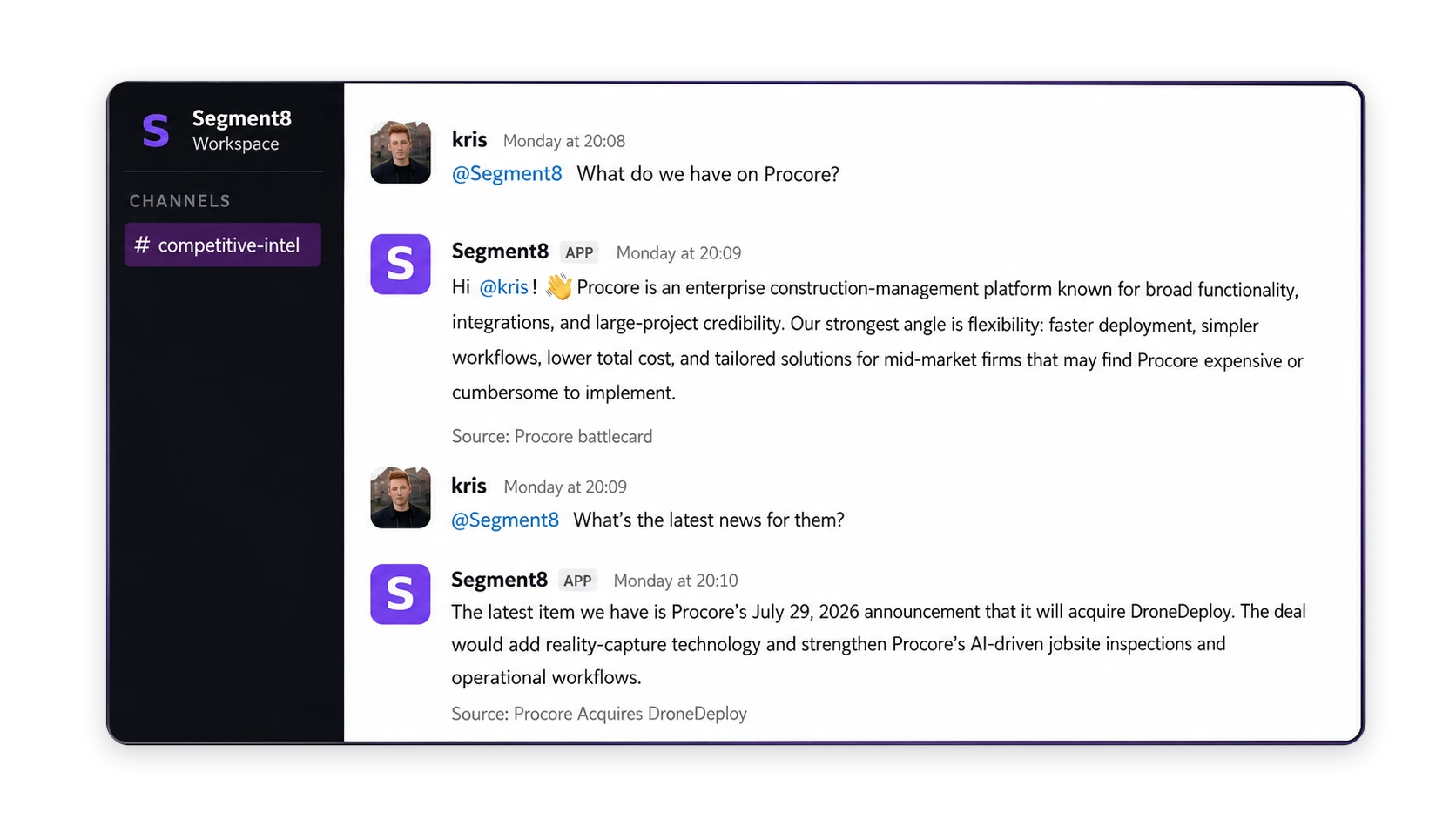
Playlists bring approved guidance and exports together for a product, competitor or launch. A seller can receive the relevant battlecard, message and supporting material as one collection. Answers in enabled channels can also point to the source when someone needs more detail.
Email delivery status shows whether a message was accepted, delayed, bounced, failed or suppressed. The people managing the communication can see what happened. The team has a route from preparing the answer to getting it to the audience, with ownership of the guidance still clear.
Build a review routine around decisions and finished work
A useful competitive review should help the team decide what to do next. Look at the relevant Signals, new deal evidence and buyer questions. Choose the responses worth working on, then check the assignments already in progress.
Segment8 gives that discussion clear records to use. The owner can explain the source and the requested change. A manager can follow progress. A reviewer can see the version and decision needed. The conversation can stay focused on getting a useful answer ready.
This helps the team learn which research leads to work that matters. A finding may change a battlecard, a message or a launch plan. Another may need more investigation. Your team can make that choice with the evidence in view, then give the response a clear owner and result.
Keep responsibility clear as more people get involved
A competitive response can need input from several people. A researcher may find the change. A product specialist may help check the claim. Product Marketing may write the answer, while a manager or another reviewer approves it. Sales then uses the finished guidance.
Segment8 gives those people different roles in the work. The owner remains responsible for the content. Collaborators help prepare it. Approvers review it. The seller audience receives and uses the approved answer. Sharing the guidance with more sellers does not have to turn them into the editing team.
This is useful when a finding affects several products or launches. Each response can have an owner and a due date, while the people involved can still see the source and the reason for the work. A manager can follow progress without having to ask every person for a separate account of where the task stands.
The result is a clearer working process. Your team knows who should prepare the response, who needs to check it and who will use it. New findings can move through that process instead of creating another round of informal messages to establish who is doing what.
Choose a system that helps you finish the response
Crayon covers competitive monitoring and enablement. Segment8 makes its case through the connected product marketing work that follows a finding: deal and buyer research, content preparation, assignments, approval and launch planning.
Bring a current competitor announcement to a demo. Follow it into the evidence, assignment and content update. Open the approval view and look at the final guidance as a seller would. That shows how the team can complete the response, rather than leaving the discussion at a list of monitoring features.
For Product Marketing teams that own both research and the action that follows, this is a practical reason to bring the work together. Request a Crayon alternative demo around a market change your team needs to respond to.
Crayon alternative FAQs
Yes. Segment8 supports selected competitor-owned pages alongside approved news and specialist sources. Findings keep the source and competitor details. Product Marketing can inspect the material, decide what matters and prepare a response tied to the evidence.
Your team can turn the finding into an assignment with an owner, instruction and due date. The response may be a battlecard update, a new message or launch work. Segment8 keeps the source available to the people preparing and reviewing the guidance.
The approval view shows the content version, reviewers and progress. Reviewers can approve or request changes with notes. Managers can set the required approvals and require another review after edits. The history records the decisions and handoffs behind the answer.
Bring a competitor announcement and the guidance your team would need to change. Follow the source into the assignment, content update and approval. Then look at the final seller view. That shows the whole response your team can complete in Segment8.
Look at the market change beside the relevant deals and buyer feedback. A finding that affects a current objection or launch may deserve work sooner. Your team makes that decision, then gives the response an owner and a clear result to prepare.
Yes. Segment8 puts competitor findings beside HubSpot or CSV deal evidence. You can look at the relevant period, competitor and deal group, then use buyer research to investigate the question. This helps Product Marketing choose the message or proof that needs work.
Give it an owner, an instruction and a due date. A selected Signal can be assigned to the right manager or team member, with progress visible. The person receiving it can understand what prompted the request and what useful output they need to prepare.
Yes. Segment8 has built-in positioning, messaging, personas and battlecards. A finding can lead the team to review several related items. Owners and collaborators prepare the changes around the same evidence, then bring the guidance through approval.
A playlist puts approved guidance and exports together for a seller audience. Product Marketing can package the relevant battlecard, message and supporting material as one collection. The seller gets a prepared response, while the team keeps responsibility for maintaining the content clear.
It should show your team checking a source, deciding on a response, assigning the work and getting a piece of guidance approved and delivered. Use a real market change so you can see the work involved and the answer Sales would receive.