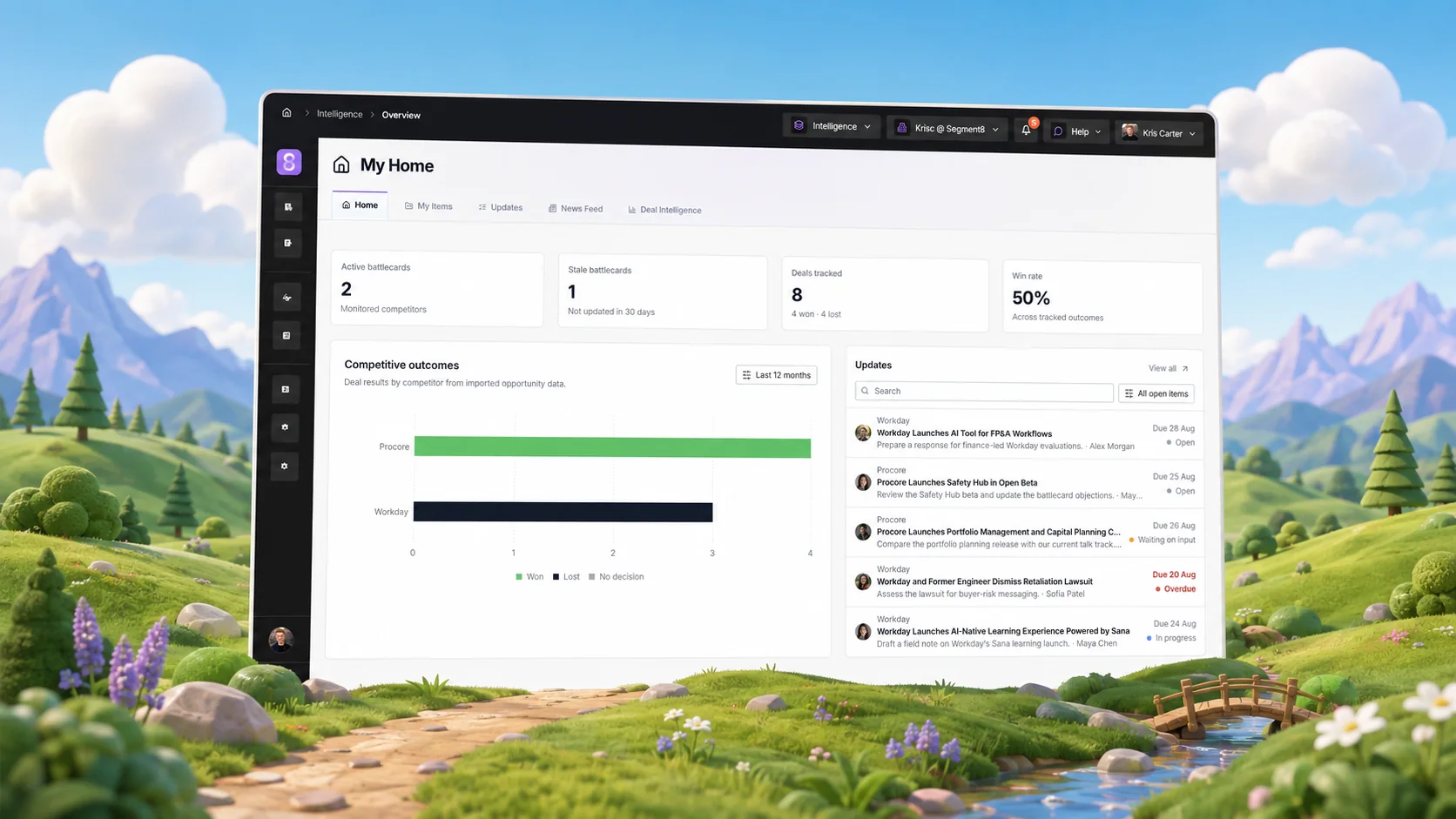
Your GTM work has become a group project. Nobody has the whole brief.
Segment8 is the GTM platform for teams that have the evidence, the people and the tools, but not one clear path from a market change to the seller answer.
The competitor tool has the alert. The CRM has the loss. The research report has the buyer quote. The launch brief has the deadline. Sales has a buyer waiting. Each system has done its little bit. The response is still missing.
These are connected parts of the same GTM operation, but most companies manage them in separate systems and hope a clever person keeps the links in their head.
Segment8 connects that work. The research behind a message stays with the decision, the plan and the people responsible. Teams can move the response forward without asking someone to reconstruct the plot from tabs and threads.
Product Marketing can update positioning, messaging and launches. Revenue leaders can see what is affecting performance and where action is needed. RevOps can connect GTM activity to commercial outcomes. Sales can work from current, approved guidance.
Sources, decisions, owners and review history stay attached to the work throughout.
Segment8 connects your CRM, market intelligence and specialist GTM tools through the context and workflows they leave fragmented. The team gets one place to move from evidence to decision, owner, approval and field guidance.
Read Why use a go-to-market platform? for the category definition and the case for connecting these tasks.
Keep the reasoning with the work
When research, messaging and launch plans live apart, every handoff needs another explanation. Segment8 keeps the context available as the work passes between teams.
| What teams need | How Segment8 helps |
|---|---|
| One connected platform | Bring market intelligence, buyer evidence, deal outcomes, messaging, launches, enablement and GTM workflows into one system. |
| GTM-native structure | Model products, personas, positioning, battlecards, launches, owners, managers, sellers and the relationships between them. |
| Owned workflows | Connect evidence to decisions, assign responsibility, manage reviews and approvals and carry work through to completion. |
| Current field guidance | Deliver approved messaging, decisions and guidance through Segment8, email and connected working channels. |
Where Segment8 fits best
Segment8 is for scaling technology companies where go-to-market has become too interconnected to manage reliably across documents, point solutions and generic workflow tools.
The need becomes clearer as teams grow. Product Marketing manages positioning, personas and messaging. Competitive Intelligence tracks the market. RevOps sees commercial outcomes. Sales hears objections directly from buyers. Enablement turns decisions into field guidance. Leadership needs to understand whether all of that work is moving in the same direction.
A competitor may change pricing. A loss pattern may emerge in the CRM. Buyer research may expose a positioning problem. A launch may require new messaging and field guidance.
These are not isolated events. Each can affect products, personas, messaging, deals, launches, owners and sellers elsewhere in the GTM system.
Segment8 keeps those relationships connected so each team can work from the same underlying context without reconstructing it independently. It works especially well when Product Marketing, Enablement, RevOps, Sales and leadership need different views of the same GTM operation.
What can teams manage in Segment8?
Segment8 combines connected GTM capabilities rather than treating market intelligence, deal learning, planning, enablement and execution as separate workflows.
| Tool | What it does | What your revenue team gains |
|---|---|---|
| Competitive Intelligence → | Monitors competitor launches, pricing, messaging and news across public sources. It classifies important changes and keeps the source attached. | Product marketing can verify the change, assess the effect on deals and brief sellers. |
| Deal Intelligence → | Maps HubSpot or CSV closed-deal data into a common model. It analyses win rate, loss reasons, deal size, time and competitor outcomes. | Revenue leaders can see changes in conversion. They can also see which competitor, segment or loss reason needs review. |
| Win-Loss → | Runs buyer research with consistent questions, personalised outreach and response tracking. It connects the answers to each decision. | Teams can learn why the buyer made the decision. They can compare the answer with CRM data and seller feedback. |
| Battlecards → | Turns market data, deal outcomes and team decisions into positioning, proof, objection handling, comparisons and a win strategy. | Sellers get one current competitive case. Review states show product marketing what needs an update. |
| Launch Planning → | Adds competitive, buyer and deal data to the market case, positioning, workstreams, owners and field-readiness plan. | Leaders can see if the launch is ready. Sellers receive a sales message based on current market data. |
The tools share source-linked information. A competitor signal can update a battlecard. A repeated loss pattern can start buyer research. The result can change positioning, improve a launch, or update guidance for the next deal.
Core strengths
Segment8 is most valuable when what one GTM team learns should change what another team does next.
| Core strength | How Segment8 works | What changes |
|---|---|---|
| Competitive intelligence | Monitors launches, pricing, messaging and news across public sources, classifies important changes, and keeps the source. | Teams can verify the change and decide which deals or guidance it should affect. |
| Deal and win-loss intelligence | Analyses CRM outcomes for repeated trends and connects them with buyer and seller explanations. | Leaders can separate what happened from why buyers made the decision. |
| Current battlecards | Links each battlecard to market signals, win-loss findings, objections, proof points and deal trends. | Sellers get current guidance. Product marketing keeps the sources and review status. |
| Launch planning | Connects the market case, positioning, messages, goals, workstreams, owners and field readiness in one plan. | Launch teams work from the same evidence used elsewhere in GTM. |
| Sales pack | Packages launch plans, battlecards, messaging and personas into a shareable sales experience. | Sellers receive the output without reconstructing the underlying context. |
Scale the response as GTM gets harder
Segment8 is built for the point where product marketing work crosses teams, systems and decisions.
A CRM can hold pipeline records. A monitoring tool can collect market activity. A document can hold a message. None of those records, by itself, gives the team the full path from change to decision, owner, review and approved guidance.
Segment8 connects the GTM context and work that crosses those systems. It is designed for decisions and workflows that involve products, markets, personas, positioning, messaging, launches, buyer evidence, deal outcomes and field guidance together.
Segment8 gives the business that path. Product Marketing can show the evidence, update the work it affects, assign the response and deliver the answer Sales needs. The value increases as more products, buyers, regions and teams depend on the same decisions.
People still make the decisions. Segment8 keeps the sources, work, owners, approvals and audience attached so the decision does not disappear into a file, dashboard or chat thread.
The product is strongest when one finding should change several parts of GTM work: a battlecard, a message, a launch plan and the answer sent to Sales. That is the work Segment8 is built to manage.
Questions answered
Competitive intelligence is part of the product marketing platform. Segment8 connects market research to buyer and deal evidence, positioning, launch plans and sales guidance. Teams can use a finding in the work it needs to change.
Product Marketing brings market knowledge into positioning and plans. Leadership uses the evidence to set priorities, RevOps helps interpret deal outcomes, and Sales and enablement put the approved guidance into practice.
Segment8 is for growing technology companies with active competitors, a repeatable sales process, and enough GTM activity for several teams to need the same market context.
Segment8 can replace a standalone competitive intelligence platform when the work extends beyond monitoring competitors and maintaining battlecards. Klue and Crayon focus on competitive intelligence. Gong focuses on calls and revenue intelligence. Segment8 connects competitor activity, deal outcomes, buyer research, launch planning, and seller guidance.
Segment8 imports deal outcomes from your CRM. Teams can compare win rate, loss reasons, competitor frequency, and segment performance with market signals and buyer feedback. That evidence can update a battlecard, message, or launch decision.
Request a product demo at segment8.com/demo to see how Segment8 connects competitor activity, deal outcomes, buyer feedback, product context, and GTM guidance in one platform.