FOR IMMEDIATE RELEASE
New capability gives product marketing teams a single workspace from competitive context to launch day execution
- Segment8 launches Launch Plans, giving product marketing teams a five-section structured workspace to connect competitive context, positioning, execution timelines, and post-launch monitoring in a single workflow.
- Product launches expose go-to-market coordination gaps at the moment they are most costly, as product, marketing, sales, and customer-facing teams need a shared view of what is shipping, why it matters, and how the field should talk about it.
- Launch Plans connect strategic rationale to tactical execution through a four-phase lifecycle model, with direct integration to Segment8's GTM Roadmap and Messaging Frameworks.
- The module gives PMMs a clearer way to plan launch scope, align stakeholders, prepare field enablement, and monitor what happens after launch day.
MANCHESTER, UK, February 10, 2025 — Segment8, the GTM Intelligence Platform for revenue teams competing in active markets, today announced the launch of Launch Plans, a structured workspace for product marketing managers to connect strategic rationale, competitive context, execution planning, and post-launch monitoring in a single workflow.
Product launches at most B2B SaaS companies are coordinated across product, marketing, sales, customer success, and leadership through a mixture of spreadsheets, project management tools, documents, and Slack threads. Each tool may serve its immediate purpose. Together, they often create a fragmented launch motion.
The strategic rationale lives in one document. The execution checklist lives somewhere else. Competitive context sits with the PMM. Messaging may live in a deck. Sales enablement may arrive in a separate brief. Product status sits inside an engineering tool. By the time the launch reaches the field, the original story has often weakened into a set of tasks, assets, and status updates.
The cost of that fragmentation has increased. Go-to-market windows are compressing. Competitors monitor announcement channels, release notes, customer pages, and product updates with increasing speed. AI-assisted content production has made it easier for competitors to update messaging, publish response content, adjust battlecards, and brief their own teams quickly after a market move.
That creates a sharper requirement for launch discipline. When a product ships, the field needs to know what changed, who it matters to, why the timing matters, how to position it, which competitors it affects, which customers should hear about it, and what proof supports the story. A launch plan has to carry the strategic logic and the execution detail in the same place.
Segment8 Launch Plans give product marketing managers a structured workspace for that work.
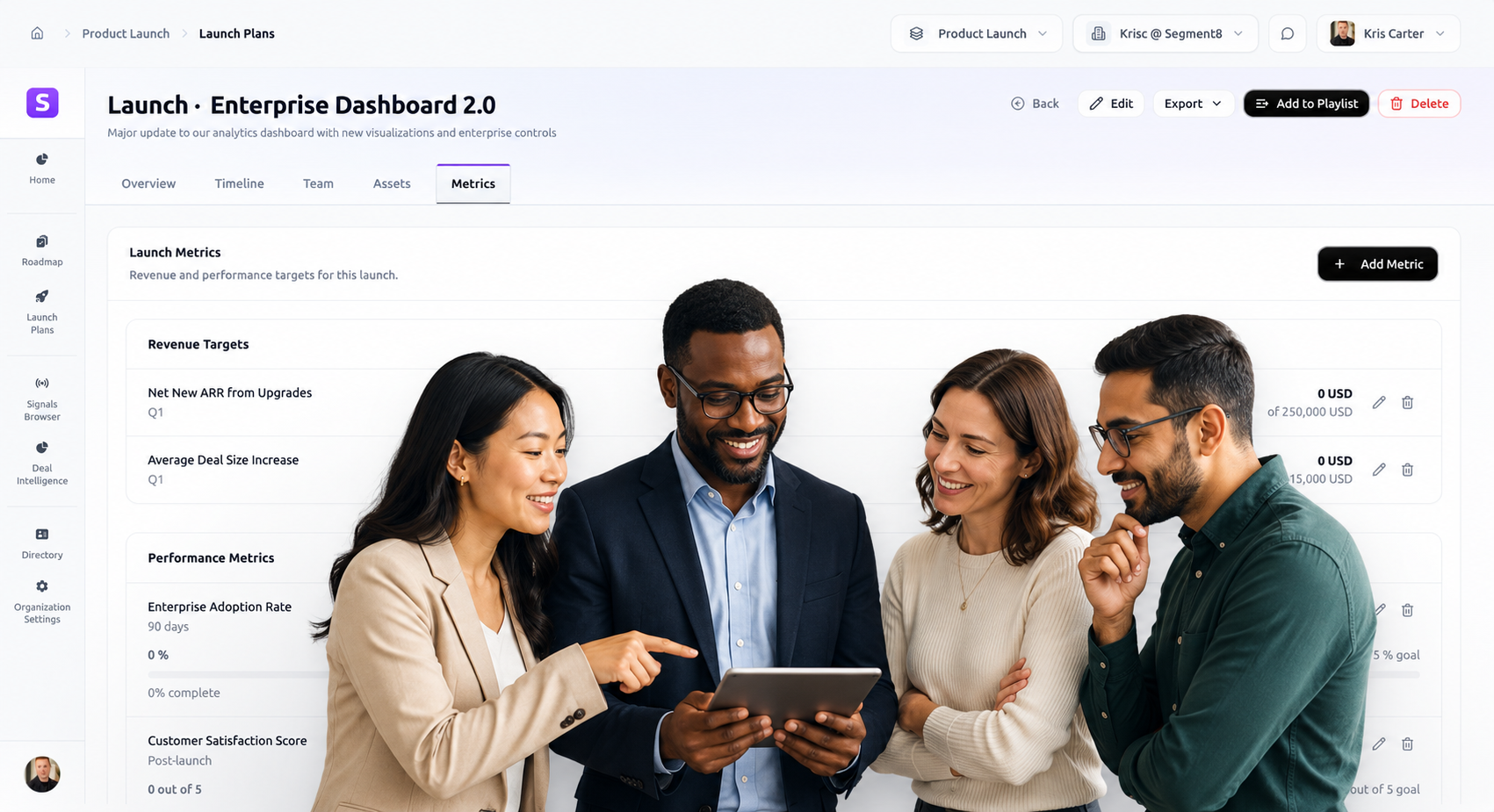
The module is organised around five sections covering strategic context, market analysis, execution planning, marketing channels, and post-launch operations. PMMs can capture the customer problem, launch rationale, target audience, competitive context, positioning, channel plan, stakeholder responsibilities, timing, and follow-up activity in one workspace.
A four-phase lifecycle model covering ideation, planning, executing, and post-launch makes launch status visible to stakeholders without requiring another status meeting. Teams can see whether a launch is still being shaped, actively planned, in execution, or under review after launch day.
Launch level classification from L1 to L4 allows PMMs to signal scope and calibrate effort. Not every release needs a major launch motion. Some features need a note, a field update, and a small customer communication. Others need messaging, sales training, executive alignment, competitive response, customer proof, campaign activity, and post-launch monitoring. Launch Plans gives teams a practical way to separate those motions and avoid treating every release the same way.
"I ran the GTM for some of the most technically complex launches I've encountered, from preconstruction workflow at Procore to AI risk management at Featurespace," said Kris Carter, Founder of Segment8. "The coordination problem was always the same. Engineering ships something real. Product marketing builds the plan. Sales needs the story. Marketing needs the angle. Customer teams need the implications. Then the launch lands, and the field is often working from a brief that arrived too late, missed the competitive context, or failed to explain why the market should care. The market does not give you a second window. The go-to-market motion has to move with the product, and that requires infrastructure rather than a better-formatted slide deck."
Launch Plans connects directly with Segment8's GTM Roadmap capability. Roadmap items ready for market execution can be promoted into launch plans with context carried over automatically. This reduces the manual translation work that often sits between product planning and launch execution, where PMMs copy information out of roadmap tools, rewrite background context, and rebuild the commercial case in another document.
Messaging Frameworks already in Segment8 can also pre-populate positioning fields, helping teams keep launch narratives aligned with the broader revenue story. This matters when a launch has competitive significance, targets a specific segment, or needs to reinforce an existing market position rather than create another disconnected message.
The module also supports distribution through PDF briefs and Excel documents, allowing launch materials to reach stakeholders outside the Segment8 workspace. That gives PMMs a way to maintain the launch plan as the source of truth while still supporting the practical reality of field distribution, executive review, and cross-functional collaboration.
For product marketing teams, Launch Plans provide a clearer operating model. PMMs can move from strategy to execution without losing the context that made the launch important in the first place. They can define scope, identify dependencies, capture competitive context, shape messaging, prepare field materials, and monitor post-launch activity in one place.
For product leaders, the module creates better visibility into how shipped work becomes market-ready. A feature may be technically complete, but commercial readiness depends on the story, audience, enablement, proof, and timing around it. Launch Plans make that layer visible.
For sales leaders, the value is field readiness. Sellers need current, specific guidance before the launch reaches customers or competitors. Launch Plans help ensure the field understands what changed, why it matters, which accounts to prioritise, and how to explain the release in a commercial conversation.
For founders and revenue operators, the module gives launch execution a firmer operating cadence. Teams can see which launches are coming, which require more support, which are under-scoped, and which may need post-launch attention because the market response is not yet clear.
The launch extends Segment8's founding product release alongside Competitive Battlecards and Win-Loss Intelligence. Competitive Battlecards help the field prepare for competitor conversations. Win-Loss Intelligence captures what buyers say after deals conclude. Launch Plans help product marketing coordinate the moments where product, market, and revenue execution need to align.
"Launches fail when the work splits into separate realities," Carter added. "Product knows what shipped. Marketing knows what is being announced. Sales knows what customers are asking. Product marketing is left trying to connect it all by hand. Launch Plans give that coordination work a proper home."
Launch Plans are available to Segment8 subscribers as part of the GTM Intelligence Platform.
Revenue teams can request a demo at segment8.com/demo.
About Segment8
Segment8 is the GTM Intelligence Platform for revenue teams competing in active markets. It connects market signals, win-loss intelligence, and field enablement in one platform so market intelligence reaches sellers before the deal is decided. Based in Manchester, UK.
Media contact
Kris Carter
Founder, Segment8
[email protected]