FOR IMMEDIATE RELEASE
New GTM Intelligence Platform gives product marketing a structured workspace to keep competitive guidance field-ready and current
- Segment8 launches Competitive Battlecards, giving product marketing managers a structured workspace to build, maintain, and distribute competitive intelligence across their revenue organisation.
- AI has compressed the time between a competitor's move and a buyer's awareness of it, while most revenue teams still rely on static slide decks, manual updates, and informal channels to brief the field.
- Battlecards connect competitive research to field execution through structured content, AI enrichment, and field readiness tracking, so sellers have current guidance before the conversation, not after.
- The launch marks the first major capability in Segment8’s wider GTM Intelligence Platform, designed to connect market signals, win-loss evidence, and sales enablement in one operating system.
Competitive intelligence has never been more abundant — or more likely to remain trapped inside a PMM’s research process. With AI compressing market cycles and buyers arriving better informed than the sellers they’re evaluating, Segment8 introduces Competitive Battlecards to give revenue teams the infrastructure to close that gap.
MANCHESTER, UK, February 6, 2025 — Segment8, the GTM Intelligence Platform for revenue teams competing in active markets, today announced the launch of Competitive Battlecards, a structured workspace for product marketing managers to build, maintain, and distribute competitive intelligence to the field.
The launch addresses one of the most persistent operational failures in B2B revenue teams: competitive intelligence exists, but it does not reliably reach the people who need it at the moment it matters.
The competitive environment has changed. AI-powered media distribution, automated monitoring tools, review sites, analyst commentary, founder-led social channels, and faster product release cycles mean a competitor's funding announcement, pricing change, product launch, or positioning shift can reach a prospect before it reaches the seller pitching against them.
That creates a sharp imbalance. Buyers now arrive in sales conversations with more live market context than many sellers have been given internally. They have read competitor pages, compared claims, seen founder posts, asked AI tools for shortlists, and absorbed peer commentary before a first call has even taken place. The seller, by contrast, may still be relying on a static PDF, a stale enablement page, or a Slack thread from several months ago.
This is not because product marketing lacks insight. In many organisations, the research is sound. The problem sits between research and execution. Competitive intelligence is gathered, analysed, and written, but then loses force as it moves through the organisation. It gets buried in decks. It dates inside shared folders. It depends on manual nudges. It becomes hard for sellers to know which guidance is current, which is under review, and which should no longer shape a live deal.
Segment8 Battlecards are designed to close that gap.
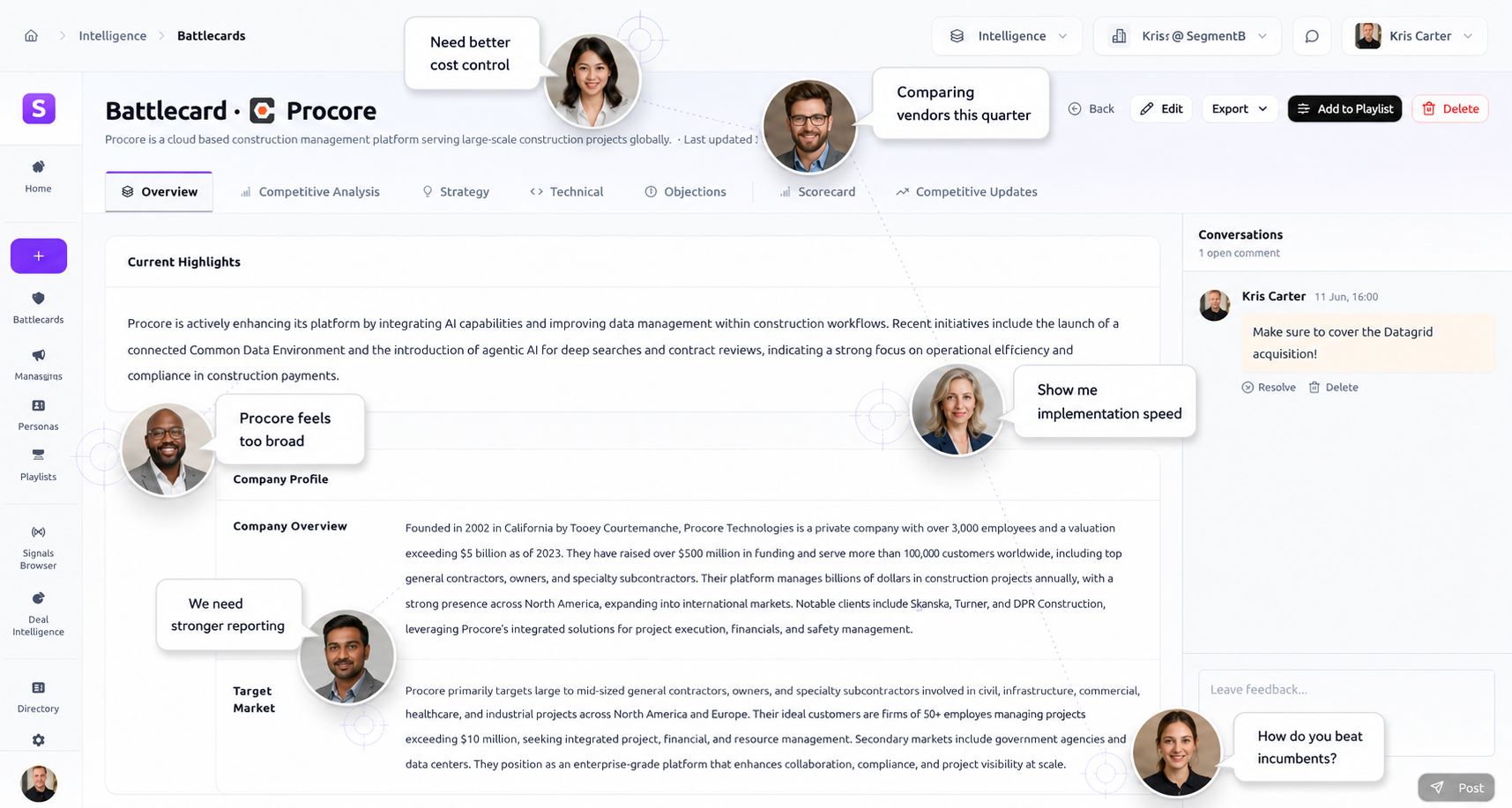
The new module gives product marketing teams a structured workspace for creating competitive guidance across analysis, positioning, objection handling, product comparisons, sales talk tracks, and field-ready narratives. Instead of treating a battlecard as a one-off document, Segment8 treats it as a living GTM asset: built from research, enriched by AI, reviewed for readiness, and distributed in formats sellers can use.
"After 15 years building go-to-market programmes across contech, fintech, and adtech, including Procore's UK market entry and Featurespace's path to acquisition by Visa, I kept watching the same failure play out," said Kris Carter, Founder of Segment8. "The competitive research was good. The intelligence was often excellent. But by the time it had been packaged, distributed, and found by the seller who needed it, the competitive conversation had already happened without it. That is not a training problem or a content problem. It is an infrastructure problem, and it is getting worse as AI accelerates the pace at which markets move. Battlecards are where that starts to change."
Competitive Battlecards include structured sections for competitor overview, market position, strengths, weaknesses, likely sales scenarios, qualification notes, objection handling, and recommended talk tracks. PMMs can use the workspace to create clearer guidance around when a competitor matters, where they are strong, where they are vulnerable, and how sellers should respond without defaulting to vague or aggressive claims.
The module also includes a structured objection library covering pricing, security, integration, value, procurement, migration, and competitive displacement scenarios. This gives product marketers a repeatable way to capture the objections sellers hear in live deals and translate them into practical responses the field can reuse.
A Comparatives scorecard helps teams assess competitors across 15 capability dimensions, giving sellers a clearer view of where the company leads, where it is at parity, and where care is required. Rather than reducing competitive positioning to blunt win-loss claims, the scorecard helps PMMs show the nuance sellers need in high-stakes conversations.
AI enrichment accelerates the research process by extracting competitive intelligence from a competitor's public website. Product marketers can use this to create a first structured view of a competitor, then refine it with internal knowledge, field input, customer evidence, and strategic judgement. The aim is not to automate positioning. It is to remove the blank page and give PMMs a faster route from signal to usable guidance.
Field readiness tracking makes content staleness visible before it becomes a deal risk. Battlecards can be marked as current, under review, or stale, giving teams a clearer view of which competitive assets are ready for the field and which need attention. For revenue leaders, this creates a practical operating layer around competitive enablement: not just what battlecards exist, but whether they can be trusted.
PMMs can export Battlecards as PDF Executive Briefs or Narrative Briefs and distribute them directly to sellers, sales leaders, founders, customer success teams, or wider GTM stakeholders. This supports both quick deal preparation and broader enablement moments where competitive context needs to move beyond the product marketing team.
The launch comes as many B2B organisations reassess how market intelligence reaches the field. Traditional sales enablement systems tend to organise finished content. Competitive intelligence tools often focus on monitoring and collection. Segment8 sits between the two. It is built for the operational layer where market signals become field guidance, where win-loss evidence informs sales plays, and where product marketing turns analysis into action.
"Revenue teams do not lose competitive deals because nobody had a thought about the competitor," Carter added. "They lose them because the useful thought did not reach the seller in time, in a form they could use, with enough confidence to change the conversation. That is the gap Segment8 is built to close."
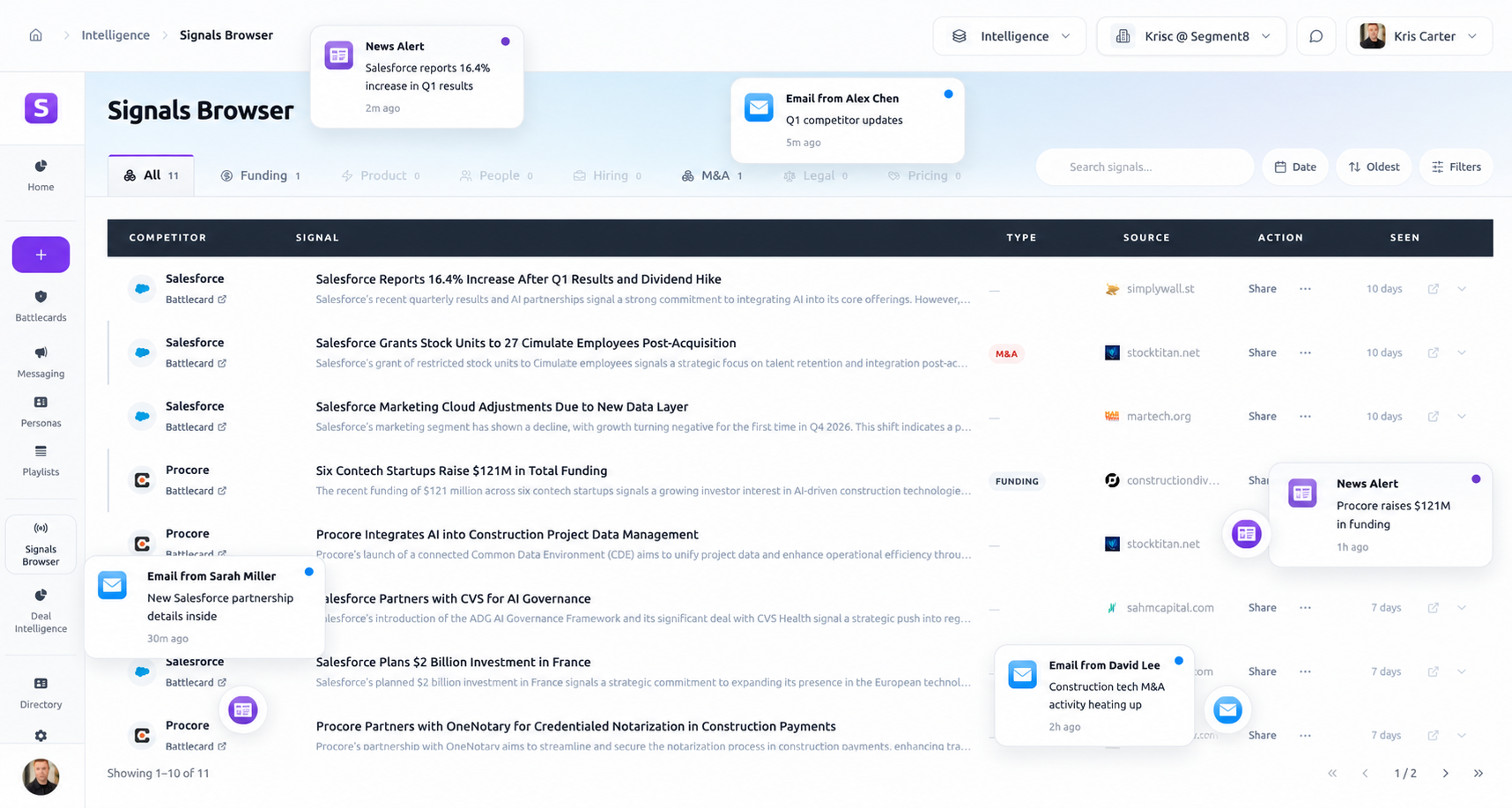
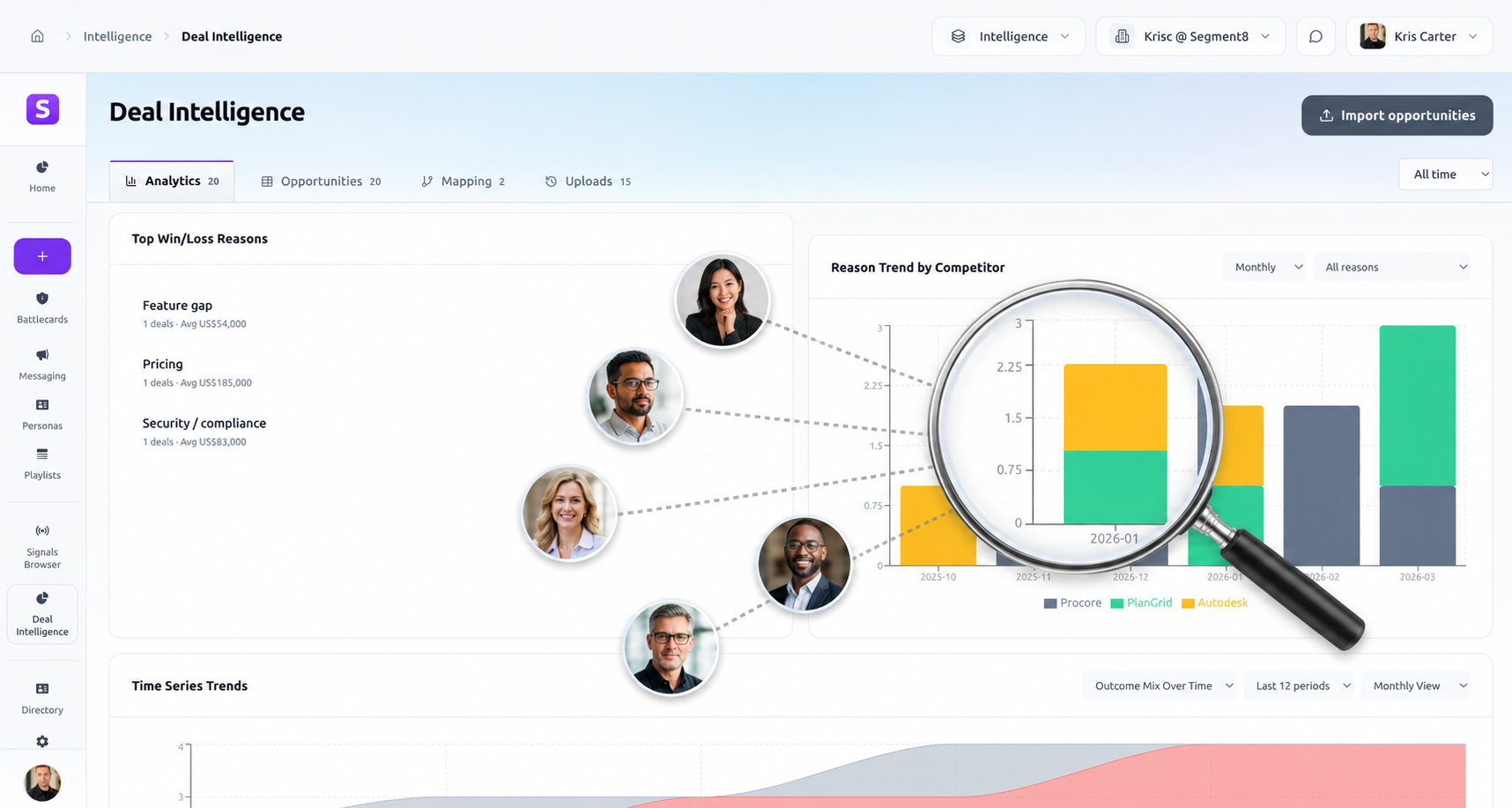
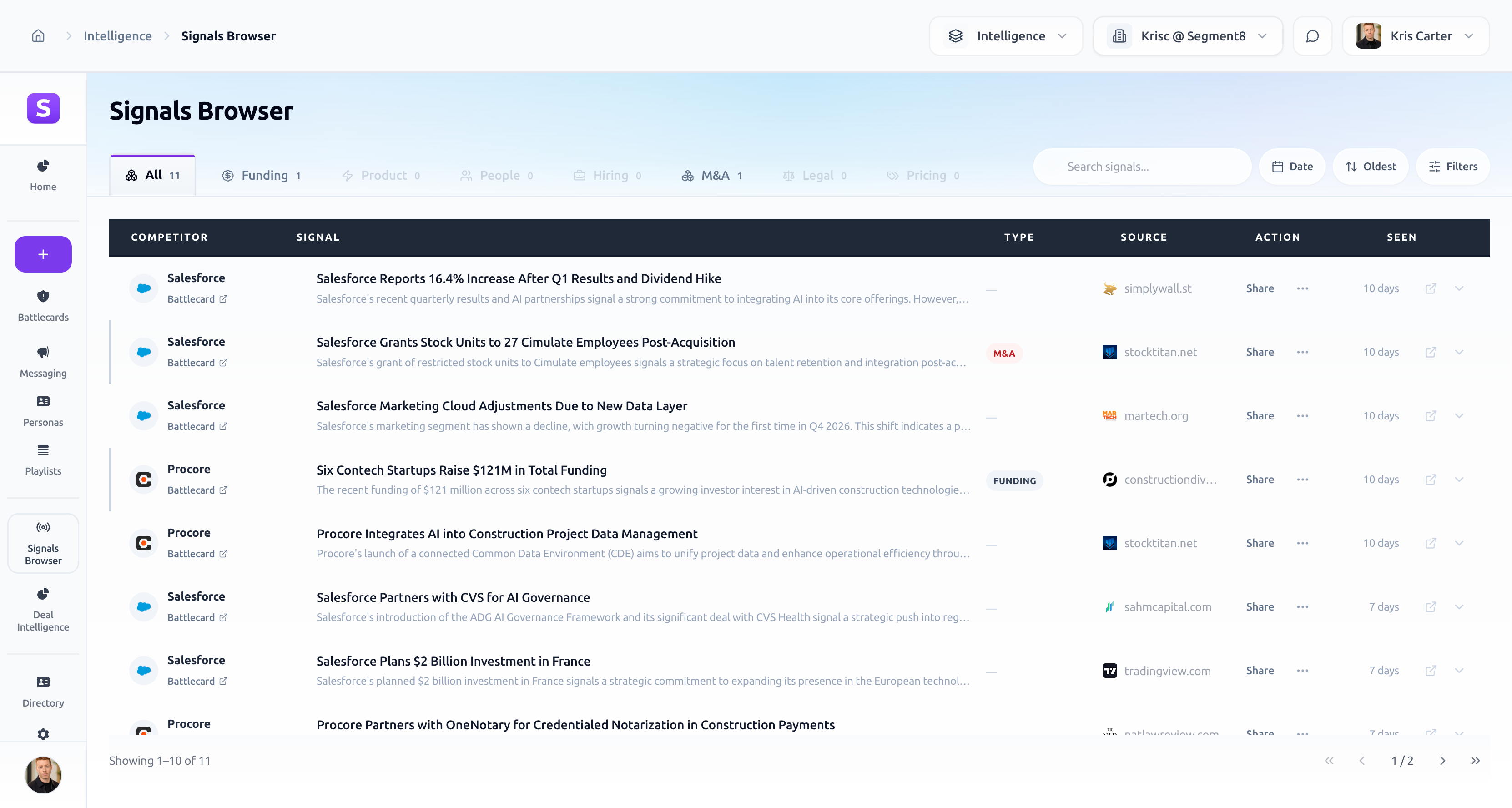
Competitive Battlecards are the foundational capability of the Segment8 GTM Intelligence Platform. Subsequent modules, including Market Signals, Win-Loss Intelligence, and Deal Intelligence, are designed to feed directly into battlecard content, keeping competitive guidance current as markets move and deals progress.
Together, these modules will help revenue teams move from episodic enablement to a more continuous GTM intelligence model, where market change, deal evidence, and field execution reinforce each other.
Revenue teams can request a demo at segment8.com/demo.
Segment8 is the GTM Intelligence Platform for revenue teams competing in active markets. It connects market signals, win-loss intelligence, and field enablement in one platform so market intelligence reaches sellers before the deal is decided. Based in Manchester, UK.
Media contact
Kris Carter
Founder, Segment8
[email protected]