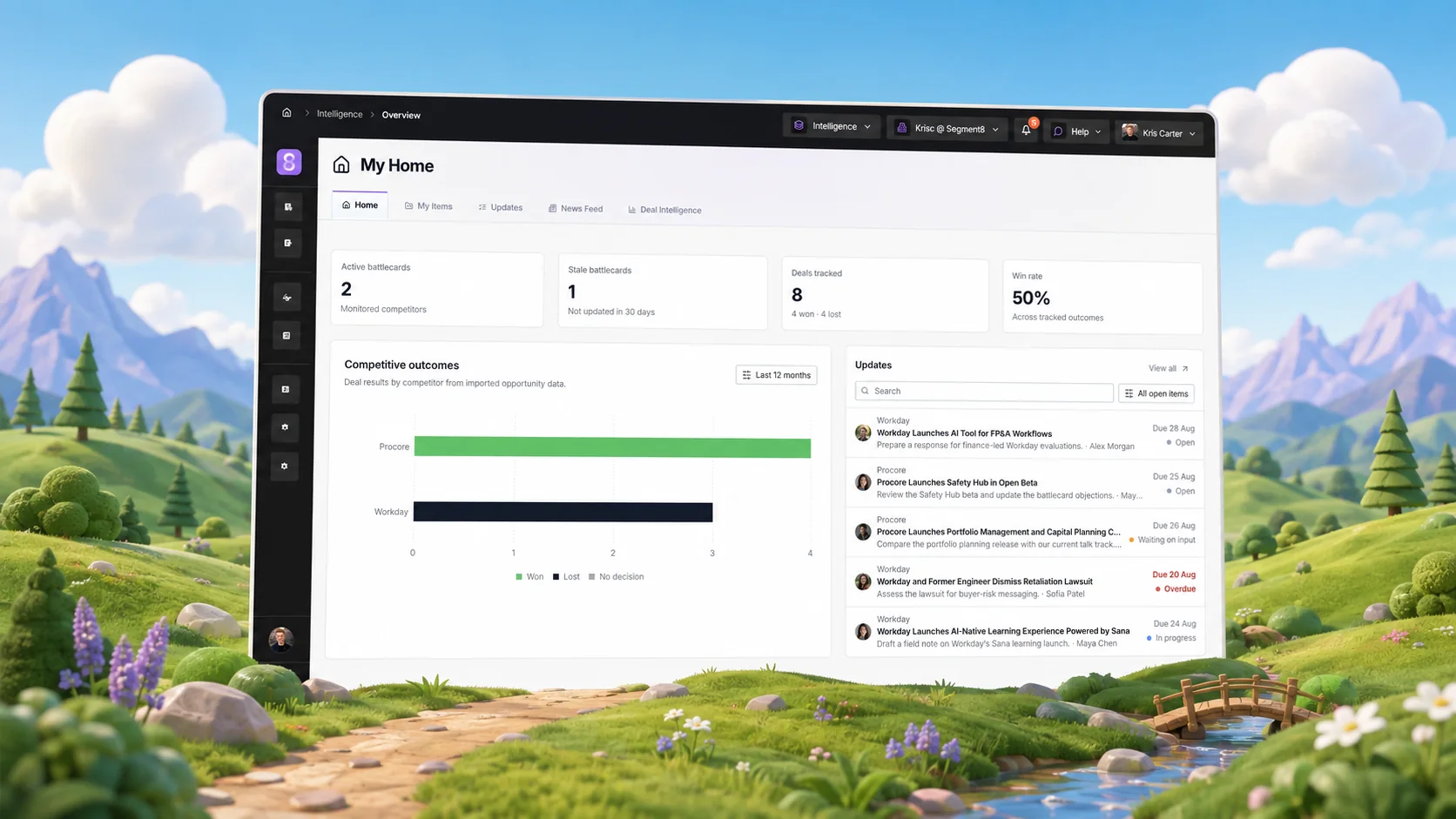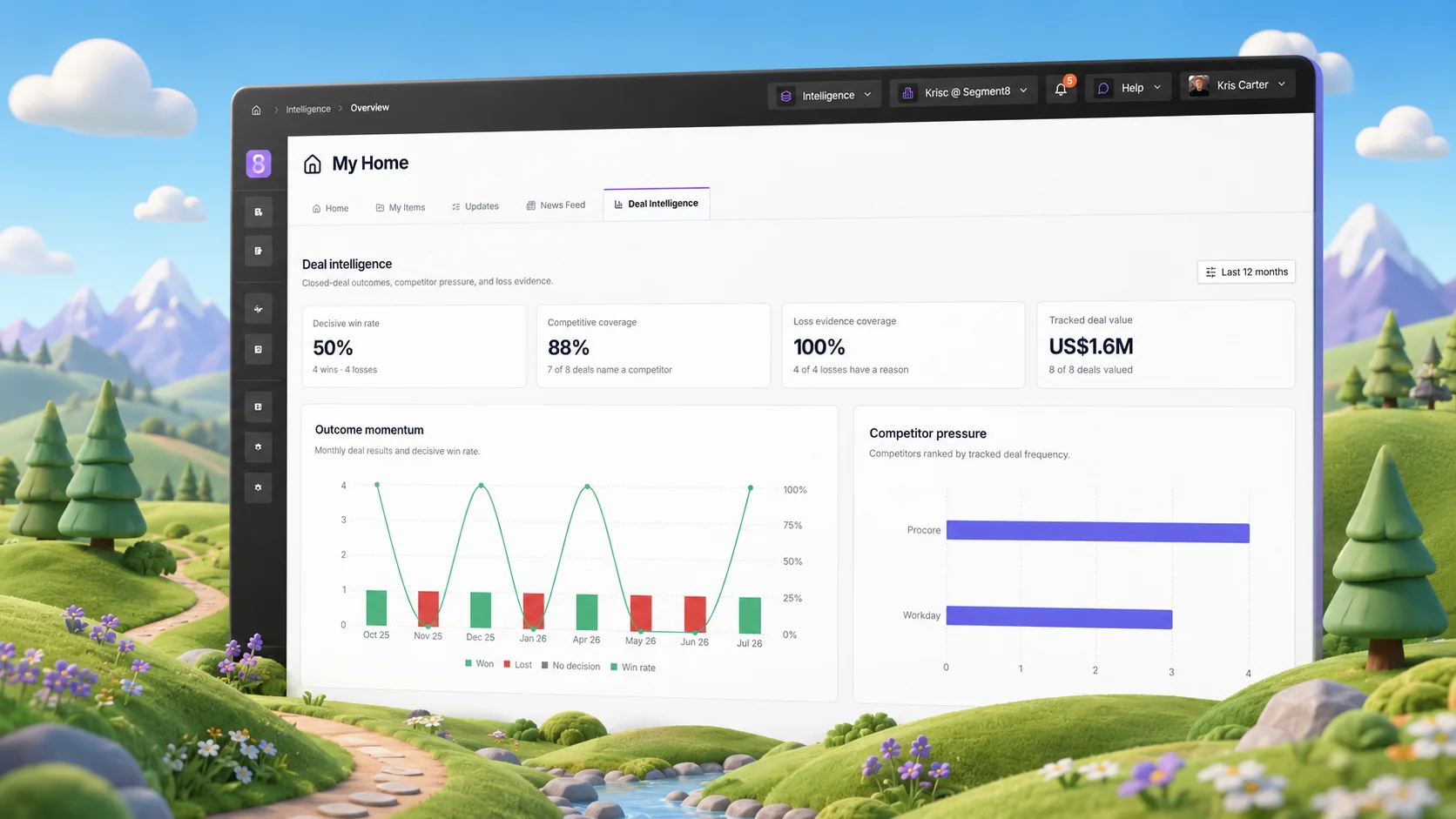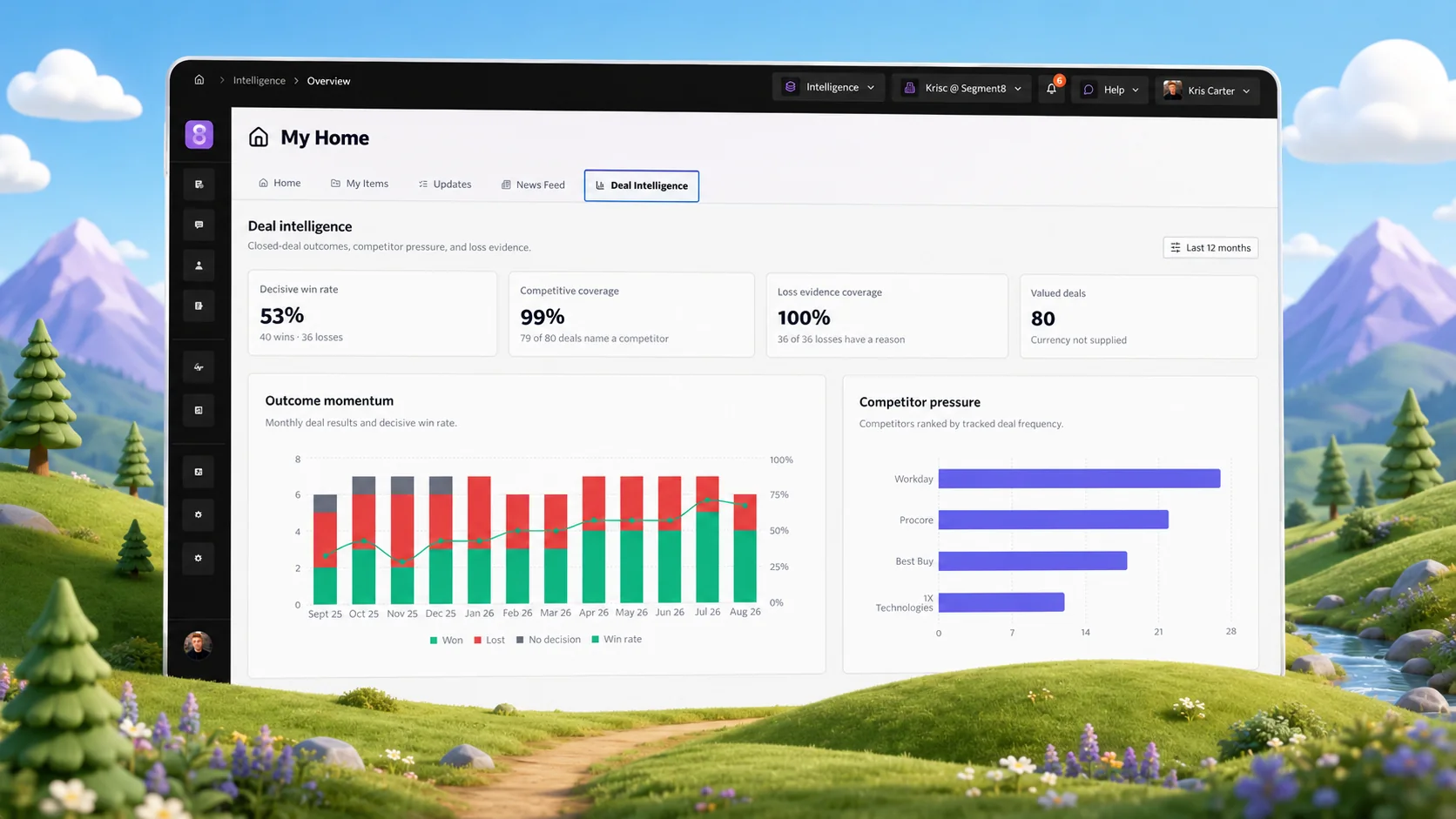
Most companies have competitive intelligence. Very few have a CI program. The difference is the gap between a shared folder of competitor screenshots and a system that connects market signals to field execution before the deal is decided.
This guide covers what CI actually does in a revenue team, the four frameworks that produce actionable intelligence rather than research artifacts, how to choose tools at different stages of program maturity, and a 90-day playbook to build the practice from the ground up.
What competitive intelligence actually does
CI serves four functional roles in a revenue team. Each requires different inputs, different cadences, and different outputs. Conflating them produces programs that are busy but not useful.
Signal monitoring tracks competitor activity — pricing changes, product launches, messaging shifts, hiring patterns, funding events — and routes relevant signals to the people who need to act on them. The output is awareness. The value is speed.
Battlecard management converts competitive intelligence into field-ready assets. Monitoring tells you a competitor changed their pricing. Battlecard management determines what that change means for deals in progress and updates the objection handler. The output is sales readiness. The value is win rate.
Win/loss tracking connects deal outcomes to competitive dynamics. It answers the question monitoring cannot: not what is the competitor doing, but what effect is it having on your pipeline. The output is pattern recognition. The value is strategic direction.
Market analysis synthesizes signals, deal data, and primary research into a view of competitive position and market direction. The output is strategic intelligence. The value is decision quality.
| Continuous CI | Project-based CI |
|---|---|
| Always-on monitoring with a regular review cadence. Right for tracking the two to four competitors that appear in your deals most often. Produces fast, incremental updates. | Deep-dive research triggered by a specific event — a competitor funding round, a new market entrant, or a strategic planning cycle. Right for decisions that require comprehensive analysis. |
The four frameworks
1. Signal-based CI
Six signal categories cover the vast majority of competitive intelligence that matters in a deal context. Pricing signals: any change to competitor pricing pages, packaging, or discount patterns. Product signals: feature launches, roadmap announcements, and beta invitations. Hiring signals: job postings reveal roadmap priorities — a wave of enterprise sales hires signals an upmarket move before the marketing announcement. Messaging signals: homepage changes, positioning shifts, and keyword acquisition. Executive signals: leadership hires and departures precede strategy changes. Market signals: analyst coverage, customer reviews, and partnership announcements.
The implementation cadence: daily automated monitoring (alerts for pricing and product changes), weekly signal review (route relevant signals to battlecard owners), monthly synthesis (update competitive profiles and flag material changes), quarterly deep-dive (reassess competitive position and prioritisation).
2. Porter's Five Forces
The original competitive strategy framework remains useful for annual market analysis and strategic planning — not for deal-level CI. Applied to B2B SaaS, the five forces map to: competitive rivalry (direct competitor intensity and differentiation), threat of new entrants (barriers to entry and your category's attractiveness to funded startups), threat of substitutes (do-nothing and build-internally options, not just other platforms), buyer power (deal concentration, switching costs, buyer sophistication), and supplier power (AI API costs, distribution dependencies, platform risks). Use this framework annually to stress-test your market position, not weekly for sales execution.
3. Win/loss-driven CI
The most field-grounded CI framework because it sources intelligence from the buyers who evaluated your competitors firsthand. The workflow: flag competitive deals in CRM at stage entry, trigger buyer interviews within two weeks of close, code themes from transcripts by competitive factor, surface patterns to battlecard owners monthly. Win/loss-driven CI answers the question that all other CI frameworks cannot: not what are competitors doing, but what effect is it having in your deals, in buyers' own words.
4. Continuous vs. project-based CI
Most effective programs split their CI investment roughly 70/30 between continuous and project-based work. Continuous CI keeps the field current on competitors they face every week. Project-based CI goes deep on specific questions — a new competitive entrant, a major competitor rebranding, or a strategic planning cycle. The split matters because the two types of CI require different skills, different tools, and different stakeholder audiences.
The programs that produce the most revenue impact are not the ones with the most sophisticated monitoring setup. They are the ones that consistently get the right intelligence to the right rep at the right moment.
Tool categories
Manual / DIY stack
Google Alerts for competitor brand and product name mentions. RSS feeds from competitor blogs and press release pages. A shared spreadsheet for tracking changes and routing to battlecard owners. Call recording review (Gong, Chorus, or Zoom) for field intelligence. This stack costs nothing beyond time and is the right starting point for teams that have not yet established a CI practice. Its limitation is that intelligence aggregation and distribution are entirely manual — which means the program is only as consistent as the person running it.
Dedicated CI platforms (Klue, Crayon)
Automated monitoring at scale with battlecard management and distribution features. Right for teams that have outgrown the manual stack and have a program owner with bandwidth to configure and maintain the platform. The buying risk: purchasing a CI platform before establishing the practice produces an expensive, underutilised subscription. The platform amplifies a working process — it does not create one.
GTM platforms with CI (Segment8)
Platforms that combine CI monitoring with win/loss analysis, battlecard management, and sales enablement in a single workflow. The advantage is that intelligence connects directly to sales outcomes — a competitor signal flows into a battlecard update that flows into a deal record — without requiring manual handoffs between disconnected tools. Right for teams that want CI as part of a broader revenue intelligence practice rather than as a standalone research function.
Point solutions
G2 and Gartner Peer Insights for review intelligence. SimilarWeb for traffic and audience data. BuiltWith for technology stack analysis. LinkedIn Sales Navigator for hiring signal tracking. These are high-value supplements to a CI program, not replacements for one. Each answers a specific question extremely well and no other question at all.
First 90 days: implementation playbook
Weeks 1–2: Baseline and prioritisation
Pull three months of CRM data and identify the competitors that appear most often in closed deals — not the ones you perceive as most threatening, but the ones that actually show up in your pipeline. Interview five to eight reps and ask them what competitive information they wish they had before calls. This tells you where the intelligence gaps are and what format will actually be used. Do not build anything yet.
Weeks 3–6: Minimum viable program
Set up monitoring for the top two to three competitors: Google Alerts, RSS, and manual homepage checks weekly. Create or update battlecards for those same competitors using the field intelligence from rep interviews. Establish a weekly 30-minute review rhythm with a designated owner. Distribute the updated battlecards through whatever channel reps already use — do not introduce a new tool until the content is trusted.
Weeks 7–12: Formalise and scale
Add a win/loss interview trigger to your CRM. After ten to fifteen interviews, run your first synthesis session: what competitive themes appear most often in losses? What is driving your most defensible wins? Use those findings to update battlecards and brief sales leadership. This is the point where CI transitions from a research exercise to a revenue input. That transition is what justifies tooling investment.
Common mistakes
Monitoring everything, acting on nothing. CI programs that generate a high volume of alerts without a clear triage and routing process create noise, not intelligence. Every signal needs an owner, a relevance threshold, and an action type — update the battlecard, brief sales, escalate to leadership, or file and ignore.
Treating competitor marketing as intelligence. Competitor website copy, press releases, and case studies tell you what a competitor wants you to know. Hiring patterns, customer reviews, call recording transcripts, and buyer interviews tell you what is actually happening. Weight primary intelligence sources over secondary ones.
Building CI infrastructure before establishing the practice. Purchasing a CI platform before you have a process produces an expensive, underutilised subscription. Build the manual practice first. When the manual process is consistently producing value and breaking under its own weight, that is when tooling investment has the highest ROI.
No distribution mechanism. Intelligence that lives in a shared drive or a CI tool nobody checks does not reach the field. The output of your CI program needs to connect to the channels reps actually use — CRM, Slack, call prep tools — not require reps to seek it out.
Measuring activity instead of impact. Battlecards created, signals processed, and updates shipped are activity metrics. Win rate in competitive deals, competitive displacement rate, and rep confidence score are impact metrics. Track both — but optimise for impact.
Questions answered
How much should we spend on CI tooling?
Price the operating model, not only the licence. Include source coverage, programme ownership, review time, distribution and the cost of maintaining manual or custom workflows. Buy tooling when it removes a measured constraint in that system and can connect to a commercial outcome.
Should we build CI infrastructure internally or buy a platform?
Compare the full maintenance burden. An internal system needs owners for source changes, failed ingestion, access control, analysis and delivery. A purchased platform still needs programme ownership and review. Choose the option whose ongoing responsibilities your team can actually staff.
Which framework should we start with?
Signal-based CI combined with a continuous monitoring cadence. It is the most actionable starting point because it connects to something you can do immediately — set up monitoring for the two or three competitors that appear in your deals most often, and establish a weekly review rhythm. Once that is running, layer in win/loss-driven CI as your deal data matures.
How do we get sales to engage with CI output?
Ask sellers which questions recur in competitive deals and which channels they already check. Deliver a small set of relevant guidance there, then measure access and field feedback. Context and timing can reduce retrieval work, but no channel guarantees adoption.
How do we measure whether our CI program is working?
Three leading indicators: battlecard adoption rate (are reps accessing the content?), win rate trend in competitive deals over the trailing quarter, and time-to-update (how quickly do battlecards reflect competitor changes?). One lagging indicator: competitive displacement rate — deals where you replaced an existing competitor. Track all four from the start so you have a baseline when leadership asks for ROI evidence.
What signals are most worth monitoring?
Ranked by strategic value: pricing changes (immediate deal impact), product launches and feature announcements (change the competitive comparison), hiring patterns (reveal roadmap priorities and expansion plans), messaging changes on the website and homepage (signal positioning shifts), and funding announcements (signal growth trajectory and likely GTM investment). Executive hires and departures matter too — leadership changes often precede strategy changes.
How do we handle CI for a market with many small competitors vs. a few dominant ones?
Use your deal data rather than competitor size alone. In a fragmented market, prioritise the competitors that appear most often in commercially important deals. In a concentrated market, track fewer competitors in greater depth and compare market movement with win-loss and CRM outcomes.